Why Your Squat Feels Completely Different From One Session to the Next
Quick Answer: Sleep quality, hydration, and even how recently you’ve moved that day all affect joint stiffness and neural readiness for a squat, which is why the exact same weight and form cue can feel smooth one session and noticeably off the next — it’s usually not a form breakdown.
Same bar, same weight, same warmup. Monday it moved like nothing. Wednesday it felt like wading through sand. Before assuming your form broke down, it’s worth knowing how much day-to-day variability is completely normal.

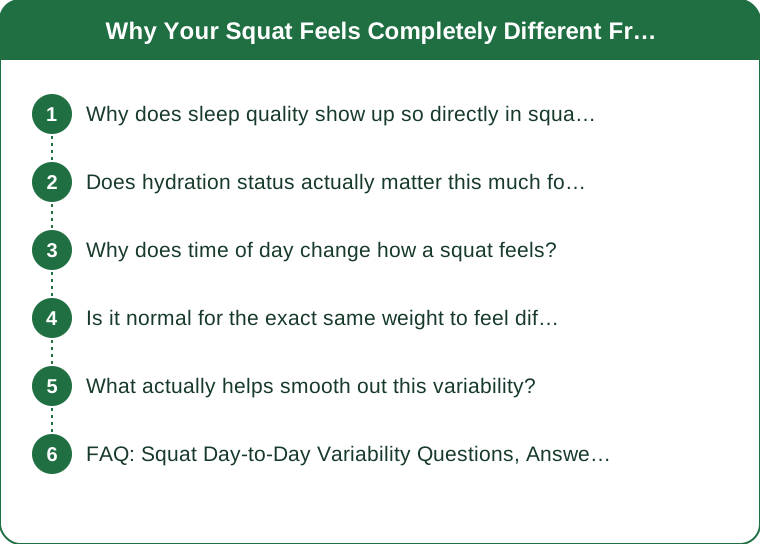
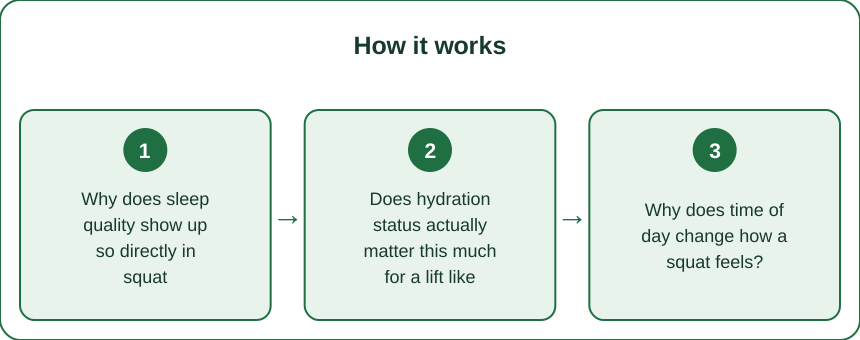
Why does sleep quality show up so directly in squat performance?
Poor sleep reduces neural drive — the efficiency with which your nervous system recruits muscle fibers for a given lift — measurably, even when muscle soreness or fatigue isn’t otherwise noticeable. A rough night’s sleep can make a familiar weight feel meaningfully heavier the next day for reasons that have nothing to do with strength loss.
Does hydration status actually matter this much for a lift like squats?
It does, more than most lifters expect — even mild dehydration reduces measured strength output and increases perceived effort during resistance training, according to research on hydration and exercise performance. A day of low water intake before training can quietly account for a session that felt harder than it should have.
Why does time of day change how a squat feels?
Joint and muscle stiffness is naturally higher earlier in the day, before movement and body temperature rise, which is part of why a morning squat session can feel stiffer through the hips and ankles than the same session done in the evening after a day of general movement.

Is it normal for the exact same weight to feel different two days in a row without any obvious cause?
Yes — daily readiness varies from a combination of stress, sleep, hydration, and even minor unnoticed fatigue from the day before, and this variability is completely normal training reality rather than a sign something is wrong with your form or programming.
What actually helps smooth out this variability?
Tracking sleep and hydration alongside your training log, even loosely, often reveals a pattern explaining “bad” squat days after the fact. A longer, more deliberate warmup on days that feel stiff — rather than jumping straight to working weight — accounts for the reduced readiness directly instead of fighting through it.
FAQ: Squat Day-to-Day Variability Questions, Answered
Should I still attempt my planned working weight on a day the warmup feels off?
It’s reasonable to adjust down slightly on a clearly off day rather than forcing the planned number, since form quality under fatigue matters more than hitting a specific weight that session.
How much day-to-day strength variation is considered normal?
Research on daily strength fluctuation suggests swings of several percent session to session are common and not a sign of losing fitness.
Does this variability mean my program isn’t working?
No — programs are built around weekly and monthly trends, not single-session feel, so one rough day doesn’t reflect overall progress.
TL;DR:
- Sleep quality measurably affects neural drive and how heavy a familiar weight feels the next day
- Even mild dehydration reduces strength output and increases perceived effort
- Joint stiffness is naturally higher earlier in the day before general movement warms things up
- Tracking sleep and hydration alongside training often explains “bad” squat days after the fact
A squat that feels off isn’t automatically a form problem — readiness genuinely varies day to day, and a longer warmup on stiff days works better than forcing through it.
See It in Motion
Seen here: High Waist Yoga Leggings with Side Pockets — shop it on bubblelime.com
Keep Reading
This article is for general informational and styling purposes only. Fit, sizing, and product availability may vary.