7 Reasons Your Bracing Fails Before Your Legs Do
Quick Answer: In most squat sets that fail, the brace goes before the legs do — the midsection loses pressure, the torso folds forward, and the legs are suddenly asked to move a load through a worse lever. The seven causes below are almost all fixable in setup rather than in strength, which is why a bracing problem often looks like a plateau and disappears in a session.
You racked the bar and your legs did not feel finished. Your lower back did.
That is the signature of a bracing failure rather than a leg failure, and they need completely different fixes.
Here are the seven that account for nearly all of them.

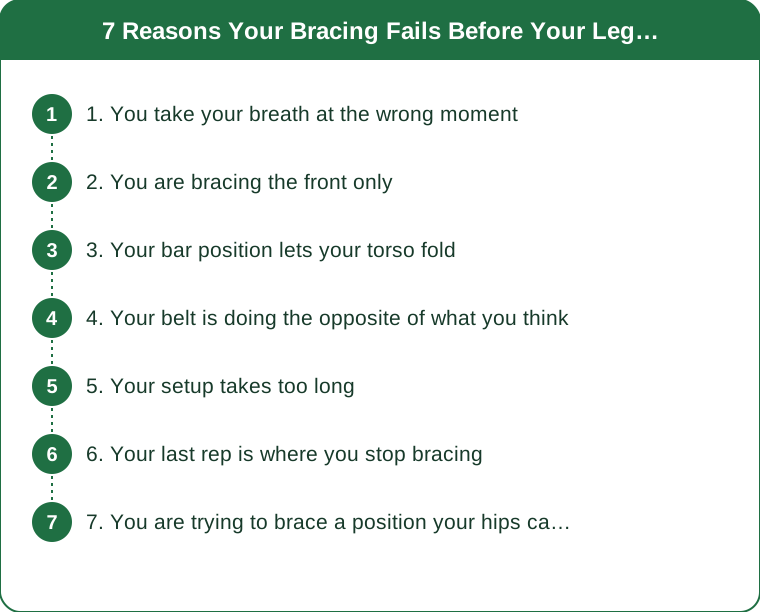
1. You take your breath at the wrong moment
The most common single cause, and the easiest to fix.
Most people breathe in as they start to descend, or worse, at the bottom. By then the bar is already loading your spine and you cannot generate full pressure.
The correct sequence: breathe in and brace while standing tall with the bar racked or just after unracking, before the descent begins. You should be pressurised before the first inch of movement.
For multi-rep sets, take the breath at the top of each rep — a full one, into the belly and the sides, not a shallow chest breath.
Test it: if you can talk at the bottom of a heavy squat, you are not braced.
2. You are bracing the front only
Pulling your belly button to your spine is a hollowing cue, and it is the wrong one for squatting.
Effective bracing is 360 degrees — pressure pushing outward against your abdominal wall, your sides and your lower back simultaneously. Hollowing reduces the cross-section and reduces the pressure you can generate.
The cue that works: imagine someone is about to punch you in the stomach, and breathe into your lower back and sides rather than pushing your belly forward.
How to check it: put your hands on your sides just above your hip bones. Take a bracing breath. Your hands should be pushed outward. If only your front moves, you are bracing half a cylinder.
3. Your bar position lets your torso fold
A bar sitting too high on the traps with a narrow grip and high elbows sets up a more upright squat but demands far more from your upper back to hold position.
When the upper back fatigues, the bar drifts forward, and a forward bar position multiplies the demand on your brace enormously.
You feel this as the lower back rounding at the bottom of rep four or five.
The fix is usually elbows, not core strength. Elbows pointing down rather than back keeps the shelf tight. If your elbows are flaring back by the last rep, the bar is being held by your arms rather than by your back position.

4. Your belt is doing the opposite of what you think
A belt does not support your spine directly. It gives your abdominal wall something to push against, which increases the pressure you can generate.
That means a belt worn loosely, or worn without actively bracing into it, does very little. And a belt worn extremely tight can actually prevent you from taking the full breath you need, which reduces pressure rather than increasing it.
The right tension: tight enough that a full bracing breath is a real effort, loose enough that you can still take one. Usually one notch looser than people assume.
And the mistake that catches everyone: using a belt for warm-up sets. If every set is belted, you never develop the unbelted brace, and the first unbelted session exposes it.
5. Your setup takes too long
Bracing is not free. Holding maximum intra-abdominal pressure is genuinely fatiguing, and it decays.
If you unrack, take three steps back, adjust your feet twice, look around, and then descend — you may have been braced for eight to ten seconds before the rep even started.
Efficient setup: unrack, two steps, feet already known, descend. Three to four seconds from unrack to first rep.
The feet-already-known part matters. Mark or memorise your stance so you are not searching for it under load. The people who take longest to set up are usually the ones who never decided their stance.
6. Your last rep is where you stop bracing
Not physically — mentally. On the final rep, the brace usually loosens on the ascent because the set is nearly done.
This is the rep where most form breakdown, and a meaningful share of injuries, occur. The load has not decreased; your attention has.
The habit to build: stay braced until the bar is back in the rack, not until you are standing. The walk back and the re-rack are loaded, and they are performed by people who have mentally finished.
Applies double to a set you had to grind. After a hard rep, the temptation is to exhale and relax at the top. Take the breath again first, then move.
7. You are trying to brace a position your hips cannot hold
Sometimes the brace is not the problem — it is being asked to compensate for something structural.
If your hips or ankles do not allow the depth you are attempting, your body finds the range somewhere else, usually by tilting the pelvis at the bottom. That tilt breaks the brace mechanically, no matter how well you set it.
Signs this is you: your lower back rounds at a specific consistent depth, every time, regardless of load. Bracing cues do not change it.
The fix is range, not effort. Squat to just above the depth where it happens, work ankle and hip mobility separately, and let the depth come back as the range does.
This is the one people push through, and it is the one where pushing through costs the most. A brace cannot hold a position your joints cannot reach.
Should I brace this hard for light warm-up sets?
Brace properly but not maximally. The habit matters more than the intensity — a warm-up set with sloppy bracing trains sloppy bracing, and you cannot switch technique on for the heavy set.
Does bracing hard raise blood pressure dangerously?
It raises it transiently, which is normal in resistance training. If you have a cardiovascular condition or are pregnant, get individual guidance before using maximal bracing or a belt. This is general information, not medical advice.
Why does my brace feel worse first thing in the morning?
Spinal discs are more hydrated after a night lying down, which slightly reduces available range and can make the position feel different. It usually settles within a longer warm-up. Morning sessions genuinely need more preparation.
TL;DR:
- Breathe and brace at the top, before the descent — not on the way down.
- Brace 360 degrees, not by pulling the belly in.
- Elbows down keeps the bar back; a drifting bar overloads the brace.
- A belt is something to push against, and it should be one notch looser than you think.
- Set up in three to four seconds, and stay braced until the bar is racked.
- If your back rounds at the same depth every time regardless of load, it is range, not bracing.
The reason this list is worth working through is that six of the seven are setup problems, not strength problems. That means they change in a single session rather than over a training block — and a plateau that was actually a bracing failure tends to disappear the week you fix it.
See It in Motion
Seen here: High Waist Bootcut Yoga Pants with Pockets — shop it on bubblelime.com
Keep Reading
This article is for general informational and styling purposes only. Fit, sizing, and product availability may vary.