7 Squat Cues That Help Some People and Wreck Others
Quick Answer: Squat cues are corrections, not universal rules. Knees out helps someone whose knees collapse and causes a wide, unstable stance in someone whose knees already track well. Chest up fixes a rounded lifter and causes an arched back in an already-upright one. Before applying any cue, work out which error you actually make - ideally from a side-on video.
Someone tells you to push your knees out. You do, and your squat gets worse.
Someone else tells you to sit back. Same result.
Neither person was wrong. Cues are prescriptions for specific errors, and taking someone else’s prescription is how a technically fine squat gets broken by good advice.

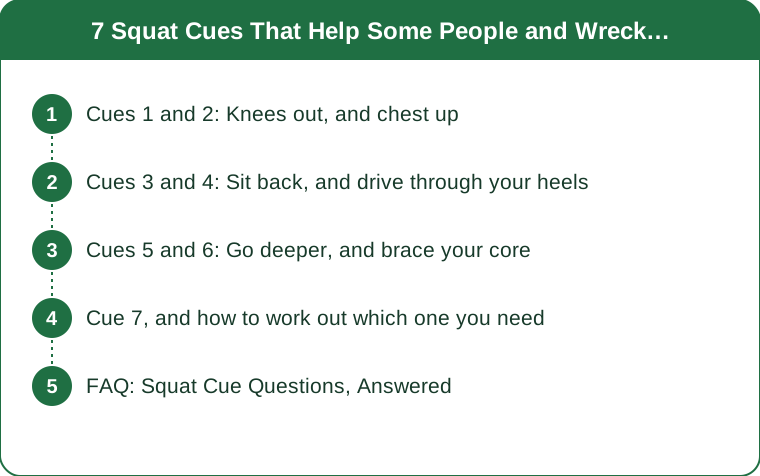
Cues 1 and 2: Knees out, and chest up
1. Knees out
Helps: lifters whose knees collapse inward under load. This is genuinely common and genuinely worth fixing, since valgus collapse under a heavy bar is one of the higher-risk positions in the gym.
Wrecks: lifters whose knees already track over their toes. Over-applying it forces the knees outside the line of the feet, which rolls weight to the outside of the foot, reduces stability, and cuts the amount of force you can produce. It also drives the stance wider than it should be, which limits depth for a lot of people.
How to tell: film yourself from the front at a working weight. If the knees move inward as you come out of the bottom, the cue is for you. If they track over the second toe, leave them alone.
2. Chest up
Helps: lifters whose torso pitches forward and whose upper back rounds, particularly out of the bottom.
Wrecks: lifters who are already fairly upright. Pushing the chest up from there produces an exaggerated lower-back arch, which loads the lumbar spine in extension under a bar and is a poor place to be. It also tends to cause the hips to shoot up first, since the body compensates.
How to tell: film from the side. If the bar drifts forward of mid-foot and the back rounds, the cue helps. If your back is already flat or slightly arched at the bottom, this cue will move you the wrong way. The better version for most people is chest proud with ribs down - keeping the ribcage stacked over the pelvis rather than flared.
Cues 3 and 4: Sit back, and drive through your heels
3. Sit back
Helps: lifters who dive straight down with the knees travelling far forward and the hips barely moving back. It is the standard fix for a knee-dominant squat and it works well.
Wrecks: lifters who already hinge substantially. Adding more sit-back tips the torso further forward, turns the squat into a good morning, and dramatically increases lower back involvement. It is also poor advice for anyone doing a front squat or an overhead squat, where an upright torso is a requirement rather than a preference.
How to tell: at the bottom, where is the bar relative to your mid-foot? Directly above it is right. If your hips are far behind your heels and your chest is toward the floor, more sit-back is the last thing you need.
4. Drive through your heels
Helps: lifters who come up onto their toes or whose weight shifts forward, which is very common and worth correcting.
Wrecks: it is the most over-applied cue on this list. Taken literally, driving purely through the heels lifts the toes, which reduces your base of support and forces the hips back - producing the good morning again. It is also part of why some people never learn to squat deep, since some forward knee travel is necessary for depth and this cue discourages it.
How to tell: the better cue for almost everyone is whole foot, or tripod foot - big toe, little toe, heel, all in contact and all loaded. If your heels genuinely lift, heel drive is a useful temporary correction. If they do not, use the whole foot.

Cues 5 and 6: Go deeper, and brace your core
5. Go deeper
Helps: lifters who stop well above parallel out of habit, caution, or ego-loading. Most people in this category can achieve depth immediately once they drop the weight, and depth is worth having.
Wrecks: lifters who are already at their available range and are being asked to find more. Forcing depth past your hip and ankle range produces the posterior pelvic tilt at the bottom that people call butt wink, which loads the lumbar spine in flexion under a bar. Hip anatomy varies considerably between individuals, and some people’s bone structure genuinely limits depth regardless of mobility work.
How to tell: unload completely and squat with no bar. If you can hit depth cleanly with body weight but not under load, it is a strength or confidence issue and more depth is available. If you cannot get there unloaded either, the limit is mobility or structure, and forcing it with a bar on your back is the wrong order of operations.
6. Brace your core
Helps: lifters who are soft through the middle and whose torso collapses under load. Genuine bracing is a real skill and worth developing.
Wrecks: lifters who interpret it as suck your stomach in, which is close to the opposite of bracing and reduces intra-abdominal pressure. It also wrecks people who take an enormous chest breath, which flares the ribs, tips the ribcage back, and both reduces stability and shortens the squat.
How to tell: if your ribs flare and your lower back arches as you set up, you are breathing into the chest rather than bracing. The correct version is a breath into the belly and lower back with the ribs staying down, then tensing as if about to be pushed.
Cue 7, and how to work out which one you need
7. Look up
Helps: almost nobody, and it persists anyway. The idea that the body follows the eyes has some limited application, and in the squat it mostly causes problems.
Wrecks: looking sharply up puts the cervical spine into extension under load, which is uncomfortable at best. It also encourages the chest-up-and-arch pattern described above. The current consensus in most coaching is a neutral neck with the eyes fixed on a point a few metres ahead on the floor, or straight ahead, and holding it throughout the lift.
The only genuinely useful part of it is having a fixed visual target, which does help with consistency and balance. Fix your eyes on something and keep them there - just do not choose the ceiling.
So how do you find your actual error?
Film from the side and from the front, at a working weight, and watch it once each. This takes four minutes and replaces months of guessing. Almost every cue on this list is a response to something visible in one of those two angles.
Apply one cue at a time and for a whole session. Stacking three cues produces a squat that is thinking about three things and doing none of them. One cue, one session, then film again.
Expect a good cue to feel wrong initially. A correction that fixes an established pattern will feel like an overcorrection for a week or two, which is why filming rather than feeling is the standard.
And drop a cue once it has done its job. Cues are temporary corrections, not permanent rules. The knees out that fixed your collapse becomes the knees out that widens your stance six months later if nobody tells you to stop.
If something hurts rather than feels awkward, that is a different question and worth taking to a physio rather than to another cue. This is general information, not medical advice.
FAQ: Squat Cue Questions, Answered
Why does my coach’s cue work for everyone else in the class?
Because a cue given to a room is aimed at the most common error in that room. Group coaching necessarily generalises, and if you do not make that error the cue will move you away from a good position rather than toward one.
Should I use cues at all once my form is good?
One or two, as a setup routine rather than as corrections. Most experienced lifters have a short fixed checklist they run before each set, and it is more about consistency than about fixing anything.
How do I film usefully with no one to help?
Phone on the floor propped against something, side-on, at about knee height, three or four metres away. Knee height matters - filming from standing distorts the bar path and makes depth impossible to judge.
TL;DR:
- Every squat cue is a correction for a specific error, and applying the wrong one actively degrades a good squat.
- Knees out, chest up, sit back, and heel drive all wreck lifters who did not have the problem they solve.
- Film from the side and from the front at knee height - four minutes replaces months of guessing.
- Apply one cue at a time for a whole session, expect it to feel wrong at first, and drop it once it has worked.
Good advice from a good coach can still be the wrong advice for you. Find your error before you go looking for a fix.
See It in Motion
Seen here: High Waist Bootcut Yoga Pants — shop it on bubblelime.com
Keep Reading
This article is for general informational and styling purposes only. Fit, sizing, and product availability may vary.