Why Your Heels Lift at the Bottom of Your Squat and What Actually Fixes It
Quick Answer: Heels lift when the squat asks your ankles for more forward travel than they have — but the ask is negotiable. A stance too narrow with toes too forward demands maximum ankle range; widening the feet and turning the toes out a few degrees can cut the requirement below what you already own. Weight drifting to the toes mimics stiff ankles perfectly, and a five inch knee to wall test settles which problem is yours in two minutes. If mobility genuinely is the limit, heel wedges and lifting shoes are a legitimate tool while loaded calf and ankle work rebuilds the range — not a cheat, an adjustment.
The heel lift is a symptom. The diagnosis takes two minutes against a wall.

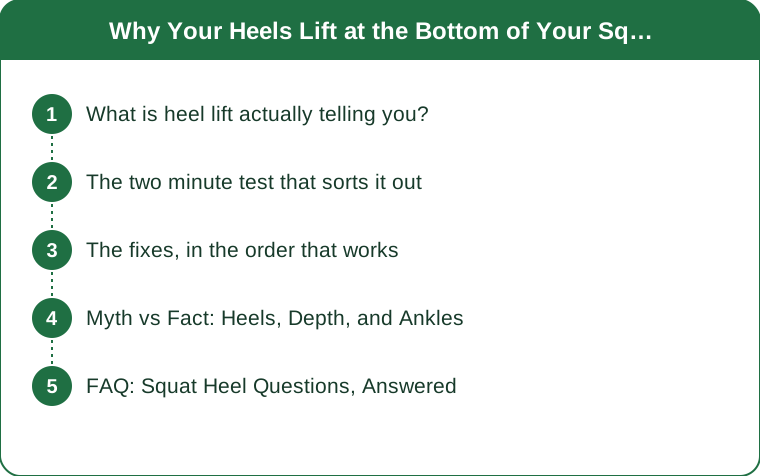
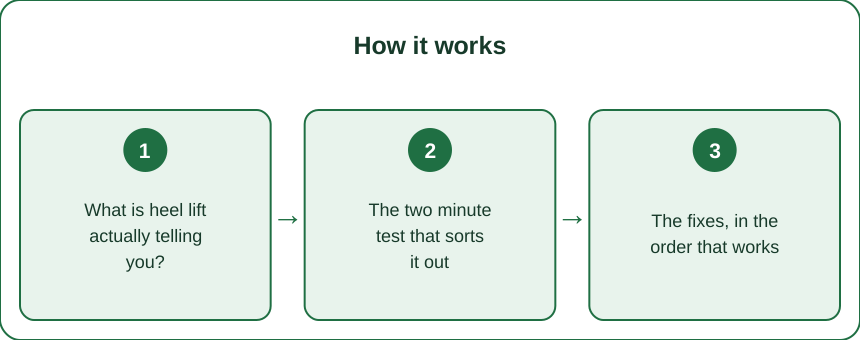
What is heel lift actually telling you?
That the geometry ran out of somewhere else and the heel volunteered — the question is which somewhere.
A deep squat is a stacking problem: hips travel down and back, knees travel forward, and the whole system has to keep your weight over the middle of your foot. The forward knee travel is paid for by the ankle bending — dorsiflexion — and when the ankle hits its end range before the squat hits depth, something has to give. The heel lifting is the cheapest available motion: the foot borrows range by tipping onto the toes.
But three different shortfalls produce the identical symptom:
Genuinely limited ankles. Some ankles simply do not have the range — old sprains, years of stiff shoes, or bone structure. Real, common, and testable.
A stance that demands maximum range. Feet narrow and toes straight ahead force the knees to travel their farthest forward path to clear the hips between them. Widening the stance and turning toes out ten to twenty degrees redirects the knees outward, cutting the forward travel the ankle must fund — for many lifters, the entire fix.
Weight in the wrong place from the start. Descend with pressure drifting to the balls of the feet — common when chasing depth or looking down — and the heels are already unweighted; the lightest lift finishes the job. This one is a habit, not a range problem, and no amount of stretching touches it.
And hovering over all three: anatomy sets different depth prices for different bodies. Hip socket shape and limb proportions mean your deepest clean squat is yours — the goal is heels down at your working depth, not somebody else’s.
The two minute test that sorts it out
The knee to wall test measures the ankle directly, so the stance and habit factors stop hiding behind it.
Setup: kneel or stand facing a wall, one foot flat, toes about five inches from the baseboard. Drive that knee straight forward toward the wall without the heel lifting.
Reading it: knee touches the wall with the heel planted at five inches — that ankle owns roughly the range a full depth squat asks for, and your heel lift is a stance or weight shift issue. Falls short at five, walk the foot in until the knee touches and measure: four inches is marginal, three or less is a genuine mobility limit that stretching and loading can actually address.
Test both sides, because asymmetry is common and explains the one-heel lift and the subtle twist out of the bottom that follows it — the stiffer ankle steals range by rotating.
Interpretation drives the plan:
Pass the test but heels still lift? Skip the stretching aisle. Work stance width and toe angle first — film a set from the side and experiment — then grip the floor with tripod feet: big toe, little toe, heel all pressing down through the whole rep. A five pound plate held at the chest as a counterweight makes the corrected pattern feel natural immediately, which is why goblet squats are the rehearsal space for this fix.
Fail the test? The heel lift is honest, and the fixes in the next section apply — including the immediate one that lets you keep training today.
Re test monthly. The number moving is how you know the boring ankle work is working, and lifters who track it stick with the program roughly forever compared to the ones stretching on vibes.

The fixes, in the order that works
First, adjust the squat to the ankles you have today. Elevate the heels: a pair of small plates under the heels, a slant board, or proper lifting shoes with a raised heel. The wedge donates the missing degrees mechanically, letting you squat deep with a planted foot and a vertical torso right now. This is equipment doing its job, not cheating — the same reason lifting shoes exist at every level of the sport. A wider stance with toes out is the zero equipment version of the same relief.
Second, build the range with load, not just stretching. Passive calf stretches feel productive and change little on their own; ankles respond to loaded work at end range:
Loaded knee over toe rocks — half kneeling, weight on the front thigh, driving the knee past the toes with the heel down, two minutes per side. Full range calf raises off a step — slow, deep at the bottom, pausing in the stretch, because the calf complex is usually the limiter. Deep goblet squat holds with the counterweight — thirty seconds accumulating at the bottom, actively pulling deeper, which is the squat teaching itself.
Consistency beats intensity: five focused minutes before each leg session outperforms a monthly mobility marathon, and meaningful change shows up on the wall test in four to eight weeks.
Third, keep the pattern honest while the range grows. Slow three second descents keep weight mid foot; pausing one inch above the failure depth teaches the exact boundary; and squatting in flat, stable shoes or bare feet — running shoe foam wobbles and hides what the feet are doing — with a mirror or phone check from the side keeps the reps truthful. A pair of squat-proof leggings and a side angle video tell you more than a training partner’s guess ever will.
The wedge and the ankle work run in parallel, and the wedge quietly shrinks as the wall test number grows.
Myth vs Fact: Heels, Depth, and Ankles
Myth: heels lifting means stop squatting until it is fixed. Fact: it means adjust — widen the stance, raise the heels, limit depth to where the foot stays planted, and keep training while the range work runs. A small lift under light load is a form note, not an injury event; the concern is heavy loads on an unstable tipping foot.
Myth: lifting shoes and heel wedges are cheating. Fact: they are standard equipment in every serious weight room, worn by lifters with excellent mobility because a raised heel improves squat geometry for most bodies. Using one while building ankle range is the textbook application.
Myth: everyone can achieve a full depth flat foot squat with enough stretching. Fact: hip and ankle bone structure vary genuinely between bodies, and some configurations will always squat best slightly elevated or slightly above parallel. The goal is your deepest strong position, not a shape from someone else’s anatomy.
Myth: knees past toes is dangerous, so heel lift does not matter. Fact: the knees past toes rule was retired decades ago — forward knee travel is normal and necessary in a deep squat. What loads knees badly is instability, and a lifting heel is exactly that. Planted heel with forward knees beats flat-shin form myths every time.
Myth: stretch the calves before every session and the problem solves itself. Fact: brief pre session prep helps the day’s reps, but lasting range change comes from loaded end range work done consistently for weeks. The wall test number is the referee — if it has not moved in two months, the current method is not the one.
Myth: it is always the ankles. Fact: the wall test exists precisely because half the time it is not — stance, weight shift, and habit produce the identical symptom and cost nothing to fix.
FAQ: Squat Heel Questions, Answered
How much heel elevation should I use?
Start small — half an inch to an inch, or standard lifting shoe height. Enough that the heels stay planted at your working depth with your torso comfortable; more than that trades away balance for no benefit. As the wall test improves, many lifters keep the shoes anyway because the geometry simply suits them.
Only one heel lifts. What does that mean?
Almost always an ankle asymmetry — confirm it with the wall test on both sides. Train the mobility work with extra volume on the stiff side, and watch for the compensations it breeds: a hip shift or slight rotation out of the bottom. One sided patterns are worth catching early.
Can I just squat to a higher depth instead?
Completely legitimate — squatting to the depth where your form holds is better training than collapsing deeper. Box squats to a consistent height make the boundary objective. Depth is a dial, not a moral test, and it can grow with the ankle work.
September gyms are packed — can I do the ankle work at home?
It is the most home friendly programming in strength training: wall test needs a wall, knee over toe rocks need a floor, calf raises need a stair. Five minutes on non gym days moves the number as fast as anything done at the rack.
TL;DR:
- Heels lift when the squat demands more ankle travel than available — but stance width, toe angle, and weight drifting to the toes fake the same symptom.
- The knee to wall test at five inches sorts mobility limits from habit problems in two minutes, per side.
- Fix in order: adjust stance, grip the floor tripod style, elevate the heels guilt free, and build real range with loaded knee over toe and deep calf work.
- Re test monthly, film from the side, and let the wedge shrink as the wall number grows.
Do the wall test tonight — both ankles, phone as the tape measure. Whichever answer you get, you know exactly which fix starts tomorrow.
See It in Motion
Seen here: Super High Waist Embossed Yoga Leggings with Inner Pocket — shop it on bubblelime.com
Keep Reading
This article is for general informational and styling purposes only. Fit, sizing, and product availability may vary.