7 Squat Cues That Work in August and Stop Working in October
Quick Answer: A cue is a temporary correction aimed at a specific fault, not a permanent rule. Cues like knees out, chest up and brace hard fix real problems, then become their own problems once the original fault is gone - producing over-corrections that quietly cap your depth, your position or your load. The signal that a cue has expired is that applying it harder no longer improves anything and often makes the rep feel worse. Review your cue list every couple of months and retire the ones that have done their job.
Someone told you to push your knees out in June and your squat immediately felt better.
It is October, you are still saying it in your head every rep, and your squat has not improved since July.

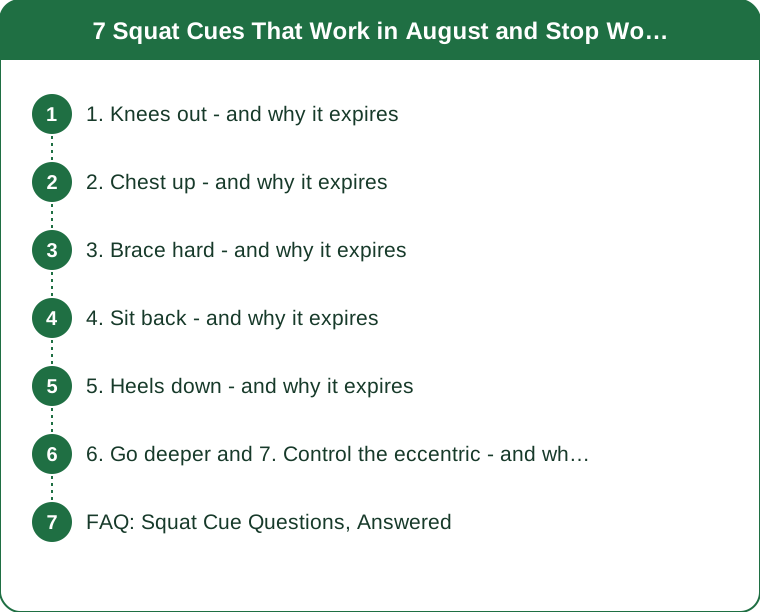
1. Knees out - and why it expires
What it fixes: knees collapsing inward under load, which is one of the most common and most worth correcting faults in a new squatter.
Why it works initially: it recruits the glutes to control hip position, and most beginners are simply not using them under load.
How it expires: once the collapse is gone, continuing to push out actively rotates the femur past the useful range, which narrows your effective stance and often reduces depth.
The over-correction sign: your knees track outside your toes and you feel pressure on the outside edge of the foot at the bottom.
Replace it with: spread the floor at the start of the rep only, and then stop thinking about your knees entirely.
Test whether it has expired: film a set without the cue. If nothing collapses, it has done its job and you can stop paying attention to it.
2. Chest up - and why it expires
What it fixes: excessive forward lean and a rounding upper back in someone who folds forward under the bar.
Why it works initially: it gives a simple external target that produces thoracic extension without a long explanation.
How it expires: overdone, it produces an extended lower back at the bottom, which is where a lot of squat-related back discomfort comes from and which reduces how much the hips can contribute.
The over-correction sign: your ribs flare, your brace disappears at the bottom, and your lower back feels the set more than your legs do.
Replace it with: keep the bar over midfoot, which is a position cue rather than a posture cue and self-corrects lean without inviting extension.
Test whether it has expired: if your upper back holds position on a set you film from the side, stop cueing it and cue the bar path instead.
3. Brace hard - and why it expires
What it fixes: a soft midsection that lets the torso shift under load, which is a genuine issue and worth training deliberately.
Why it works initially: most people have never braced properly and the improvement in stability is immediate and obvious.
How it expires: maximum brace on every rep of every set is exhausting and unnecessary. Bracing hard for a set of twelve at sixty percent burns more than it stabilises.
The over-correction sign: you are light-headed on warm-up sets, or your working sets end because of breathing rather than because of your legs.
Replace it with: brace proportionally to load - firm on warm-ups, maximal only on genuinely heavy sets.
Test whether it has expired: if a moderate brace produces the same bar path on film as a maximal one, you are spending effort for nothing.

4. Sit back - and why it expires
What it fixes: a squat that dives straight down onto the knees with no hip contribution, common in people who have only ever done bodyweight squats.
Why it works initially: it introduces the hip hinge component and gets the posterior chain involved.
How it expires: in a high-bar back squat or a front squat, sitting back too far turns the movement into a good morning, shifting load to the lower back and cutting depth.
The over-correction sign: your hips rise faster than your shoulders out of the bottom, and the bar drifts forward.
Replace it with: sit between your feet, which preserves the hip contribution without the backward drift.
Test whether it has expired: film from the side and watch the first inch out of the hole. If your hips lead, you are sitting back too much for the bar position you are using.
5. Heels down - and why it expires
What it fixes: heels lifting at the bottom, usually an ankle mobility limitation or a balance problem.
Why it works initially: it forces attention to weight distribution and often reveals that the person was simply leaning too far forward.
How it expires: if the underlying limitation is genuine ankle range, cueing harder does nothing except make the person avoid depth. A cue cannot create range that is not there.
The over-correction sign: you rock backward at the bottom and lose the bar over midfoot, or you shorten your depth to keep the heel down.
Replace it with: address the actual limitation - ankle mobility work, a wider stance, or a heeled shoe - rather than repeating the cue.
Test whether it has expired: if the heel stays down at your working depth without thinking about it, drop the cue and spend the attention elsewhere.
6. Go deeper and 7. Control the eccentric - and why they expire
Go deeper - what it fixes: habitually short squats in someone with the range to go lower, which is extremely common and worth fixing.
How it expires: chasing depth past your available hip and ankle range produces a lower back that rounds at the bottom, which is a worse trade than a slightly higher squat with a stable spine.
The over-correction sign: a visible tuck at the bottom on film. Depth beyond that point is not adding training effect.
Replace it with: squat to your deepest stable position and work on range separately outside the squat.
Control the eccentric - what it fixes: dropping into the bottom uncontrolled, which wastes tension and is genuinely worth correcting.
How it expires: a very slow descent on every set accumulates enormous fatigue for limited benefit and makes heavy sets harder than they need to be. A controlled two-second descent is not the same as a laboured four-second one.
Replace it with: control the last third of the descent specifically, which is where position is actually lost, and let the top half move at a normal speed.
And the general rule underneath all seven: hold one cue at a time. Attention is finite, and a squatter running five internal cues simultaneously executes all of them at about sixty percent.
FAQ: Squat Cue Questions, Answered
How do I know when a cue has expired?
Apply it harder for a set. If nothing improves, or the rep feels worse, the fault it targeted is gone and the cue is now producing an over-correction.
How many cues should I use at once?
One, occasionally two. More than that and none of them get executed properly, because attention during a heavy set is genuinely limited.
Should I film every session?
No, but film one working set every two to three weeks. Almost every cue question is answered instantly by video from the side and resists answering any other way.
Are external cues better than internal ones?
Research on motor learning generally favours external cues - push the floor away rather than contract your glutes - for both performance and retention. Both have a place, but default to external.
What if a cue works for one lift and not another?
That is normal. Sit back is useful in a low-bar squat and counterproductive in a front squat, because the bar position changes the mechanics entirely.
My coach gave me a cue that now feels wrong - what do I do?
Tell them. A good coach expects cues to be retired and replaced, because a cue is a tool for a specific fault at a specific time, not a permanent instruction.
Should I ever go back to an old cue?
Yes - faults reappear under heavy load, after a layoff or when fatigued. Retiring a cue means removing it from every-rep attention, not deleting it. This is general information, not medical advice.
TL;DR:
- A cue is a temporary correction for a specific fault, not a permanent rule.
- Knees out, chest up and brace hard all expire and become over-corrections once the fault is gone.
- Test expiry by applying the cue harder - if nothing improves, retire it.
- Hold one cue at a time; attention during a heavy set is finite.
- Film one working set every two to three weeks from the side and let the video decide.
- Depth beyond your stable range is not a cue problem and cannot be fixed by trying harder.
Review your cue list every couple of months and drop the ones that already worked. This is general information, not medical advice.
See It in Motion
Seen here: Super High Waist Embossed Yoga Leggings with Inner Pocket — shop it on bubblelime.com
Keep Reading
This article is for general informational and styling purposes only. Fit, sizing, and product availability may vary.