9 Squat Warm-Up Moves That Actually Change Your First Set
Quick Answer: A squat warm-up should open three specific things — ankle dorsiflexion, hip internal and external rotation, and thoracic extension — and then rehearse the actual pattern under light load. Five minutes on a bike does none of that. The nine moves below take about eight minutes total, and the ones that produce the biggest immediate change in depth are the ankle work and the deep squat hold, which most people skip entirely.
Your first working set always feels awful and your third feels fine, so you have concluded that you just need a few sets to warm up.
That is not warming up. That is spending three sets doing what a proper warm-up would have done in eight minutes, and it means your best sets happen when you are already fatigued. The sixth move on this list is the one that changes depth most immediately, and almost nobody does it.

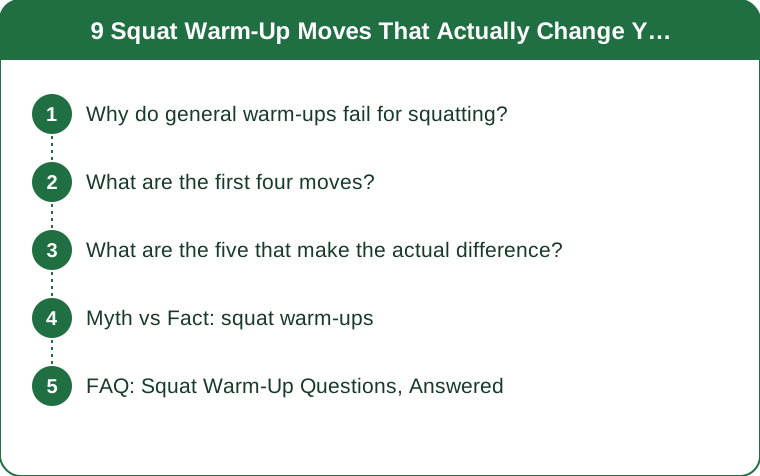
Why do general warm-ups fail for squatting?
Because raising your body temperature and opening the positions a squat requires are different problems.
Five minutes on a bike does the first. It raises muscle temperature, increases blood flow, and reduces tissue stiffness slightly — all genuinely useful.
What it does not do is address the three joint restrictions that actually limit a squat:
Ankle dorsiflexion determines how far your knee can travel forward over your toes. Restricted ankles force either a shallower squat, heels lifting, or the torso pitching forward to compensate. This is the single most common limiter of squat depth and it is completely absent from a cardio warm-up.
Hip rotation — both internal and external — determines whether you can sit into the bottom position with your knees tracking correctly. Restriction here produces knees caving in or a stance that never quite feels right.
Thoracic extension determines whether you can hold an upright torso under a bar. A stiff upper back means the bar drifts forward and the squat becomes a good morning.
Cycling, specifically, is worse than neutral for two of these. It keeps the hip in a narrow flexion range and the thoracic spine in flexion for the whole warm-up — the opposite of what you are about to need.
The fix is sequence: raise temperature briefly, open the three restrictions, then rehearse the pattern.
What are the first four moves?
1. Two to three minutes of general warming
Anything that raises temperature — brisk walking, rowing, skipping, or an easy incline walk. Two to three minutes is enough. Its only job is to make the tissue more compliant for what follows.
2. Knee-to-wall ankle mobilization
Face a wall, foot about four inches back, drive your knee forward over your toes to touch the wall without your heel lifting. 10 to 12 reps per side, moving the foot back slightly each time you succeed.
This is the highest-return move in the entire list for most people. Test it first: if you cannot touch the wall from four inches with the heel down, ankle mobility is your depth limiter, and no amount of hip stretching will fix it.
3. 90/90 hip rotations
Sit with one leg bent in front at 90 degrees and one out to the side at 90 degrees. Rotate both knees to the other side without using your hands, then back. 8 to 10 rotations.
This addresses internal and external hip rotation together, which is exactly the combination the bottom of a squat demands, and it works far better than a static hip flexor stretch.
4. Thoracic extensions over a foam roller
Roller across the upper back, hands supporting your head, extend backwards over the roller for a two-second hold. Move the roller up an inch and repeat. 6 to 8 positions.
Do this before you get under a bar rather than after — it directly determines whether you can hold the bar position without the torso folding.

What are the five that make the actual difference?
5. Cossack squats
Wide stance, shift your weight into one leg and lower into a deep side lunge, keeping the other leg straight with the toe up. 6 to 8 per side, slowly.
Trains hip abduction and adduction under load through range, which nothing else in a standard warm-up covers, and it exposes side-to-side differences immediately.
6. The deep squat hold
The move nobody does, and the one that changes depth most. Sit into the deepest squat you can hold and stay there for 60 to 90 seconds, holding onto a rack or a doorframe for support if you need it. Gently rock side to side, push your knees out with your elbows, and breathe.
This is not stretching in the conventional sense — it is spending time in the end-range position so your nervous system stops guarding against it. The difference in the first working set after 90 seconds here is usually obvious the first time you try it.
If you cannot hold the bottom position at all, hold a light weight in front as a counterbalance. That single change lets most people find a depth they thought they did not have.
7. Bodyweight squats with a three-second descent
8 to 10 reps, lowering slowly and pausing briefly at the bottom. This rehearses the pattern rather than mobilizing anything, and the slow tempo is what makes it useful — you cannot use momentum to disguise a position you cannot actually control.
8. Glute bridges
12 to 15 reps with a hard squeeze at the top. Wakes up glutes that have been sitting on a chair all day, so they contribute from your first rep rather than your fourth set.
9. Ramp-up sets
Empty bar for 8 to 10 reps. Then 40 percent, 55 percent, 70 percent, 85 percent of your working weight, dropping the reps as the weight climbs — 5, 5, 3, 2.
These are part of the warm-up, not part of the workout. Skipping them is why the first working set feels wrong, and adding them costs about four minutes.
Myth vs Fact: squat warm-ups
Myth: Static stretching before squatting improves your squat. Fact: Prolonged static stretching before heavy lifting temporarily reduces force production. Save it for after training. The mobilizations above are active and dynamic, which is a different thing.
Myth: The warm-up should make you tired. Fact: If you are breathing hard after your warm-up, you have spent energy you need. It should take eight to ten minutes and leave you feeling more capable, not less.
Myth: If you squat regularly you do not need to warm up. Fact: Regular squatting builds capacity, not readiness on any given day. Ankle and hip stiffness varies substantially day to day depending on sleep, sitting, and previous training — which is exactly why the same squat feels different every session.
Myth: Foam rolling the quads before squatting helps. Fact: It feels good and does little for the positions the squat needs. If you have limited time, spend it on ankles and the deep squat hold rather than rolling.
Myth: The warm-up is the same year round. Fact: In a cold gym, tissue is stiffer and needs longer. As the weather turns, add two or three minutes to the general warming portion and expect the first squat of the session to feel worse than it did in July.
FAQ: Squat Warm-Up Questions, Answered
How long should this actually take?
Eight to ten minutes for the mobility portion, plus four for the ramp-up sets. If you are short on time, keep the ankle work, the deep squat hold, and the ramp-up sets, and cut the rest. Those three cover most of the benefit.
Do I need to do all nine every session?
No. Test yourself with the knee-to-wall check and a bodyweight squat, and prioritize whichever restriction shows up that day. Most people have one dominant limiter that varies week to week rather than all three at once.
Should I warm up differently for high-bar versus low-bar squats?
Slightly. Low-bar demands more shoulder and thoracic mobility to hold the bar position, so add shoulder dislocations with a band. High-bar demands more ankle range because of the more upright torso, so weight the ankle work heavier. The rest is the same.
TL;DR:
- A squat warm-up needs to open ankles, hips, and thoracic spine — cardio does none of those.
- The highest-return moves: knee-to-wall ankle mobilizations and a 60 to 90 second deep squat hold.
- Follow with slow bodyweight squats, glute bridges, and proper ramp-up sets — those are warm-up, not workout.
- If short on time, keep ankles, the deep hold, and the ramp-ups. Add a few minutes as the gym gets cold.
Stop paying for your warm-up with your first three working sets. Eight minutes buys them back.
See It in Motion
Seen here: High Waist 8” Yoga Shorts — shop similar styles on bubblelime.com
Keep Reading
This article is for general informational and styling purposes only. Fit, sizing, and product availability may vary.