8 Reasons Your Squat Feels Worse After a Week Off
Quick Answer: Measurable strength loss takes roughly two to three weeks of complete inactivity. After one week off, the things that actually changed are motor pattern sharpness, joint fluid and tissue stiffness, neural drive, and — most of all — your expectations. The weight feels heavier because the coordination is rusty, not because the muscle is gone.
You took a week off and came back to a bar that felt twenty pounds heavier. Eight things that actually changed, and only one of them is strength.

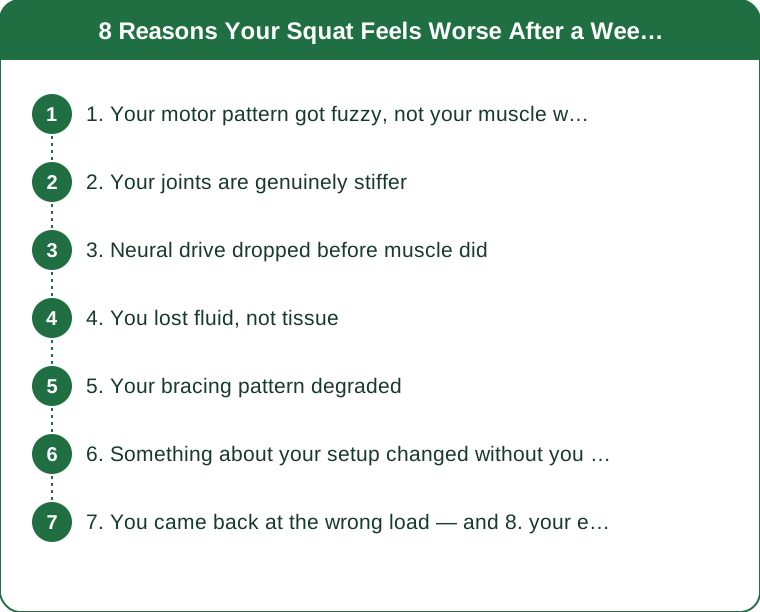
1. Your motor pattern got fuzzy, not your muscle weaker
This is the biggest single factor and the one people never suspect.
A squat is a coordinated skill, not just a force output. Bracing timing, hip and knee sequencing, foot pressure distribution, and bar path are all learned patterns that sharpen with repetition and blur slightly without it.
Seven days is enough to blur the pattern and nowhere near enough to lose the muscle. Research on detraining generally shows measurable strength decline starting around two to three weeks of full inactivity, and even then it’s modest at first.
Fuzzy coordination feels exactly like weakness from the inside. The bar feels heavy because you’re producing force less efficiently, with slightly worse timing and slightly more wasted tension.
The fix is reps, not load. Three sets at 60% with deliberate attention to the pattern re-sharpens more in one session than trying to hit your previous top set.
2. Your joints are genuinely stiffer
Not an illusion, and it resolves faster than you’d think.
Synovial fluid viscosity responds to movement. Regular loading keeps joints moving through range easily; a week of sitting more than usual leaves hips and ankles measurably stiffer at the start of a session.
Ankle dorsiflexion is the usual culprit for squats specifically. Restricted ankles change everything downstream — depth, torso angle, and where you feel the load.
This is why the first set feels worst and the third feels normal. If your third set is meaningfully better than your first, stiffness was the problem, not strength.
Extend the warm-up rather than cutting the session. Five extra minutes of ankle and hip work on the return session is worth more than any amount of pushing through.
3. Neural drive dropped before muscle did
The nervous system adapts faster in both directions than muscle tissue does.
A meaningful part of strength is neural — how completely and how synchronously you recruit the muscle you have. Neural adaptations decline faster than muscle cross-section, which is why early detraining looks like strength loss without any visible change.
It also returns fast. Most people are back to baseline within two or three sessions, which is dramatically faster than building it took.
This is the mechanism behind “muscle memory” in the short term, and it’s the reason a return week feels alarming and a return fortnight feels fine.
Don’t test your max on the return session. You’ll get a number that reflects neural rust rather than capacity, and then you’ll believe it.

4. You lost fluid, not tissue
The visual change people notice is mostly water and glycogen.
Muscle glycogen binds water at roughly 3 grams of water per gram of glycogen. Reduced training depletes glycogen, which takes the associated water with it.
The result is muscles that look and feel flatter within a few days. This reads as atrophy and isn’t — it’s a storage change that reverses within days of resuming training and normal carbohydrate intake.
Weight on the scale drops slightly too, which reinforces the impression. It’s not tissue.
Give it three or four training days before judging anything about how you look or how the muscle feels under the bar.
5. Your bracing pattern degraded
Bracing is the most perishable component of a squat, and it’s the one that most affects how heavy something feels.
Intra-abdominal pressure is a skill. The coordination of breath, brace, and load is trained and it decays with disuse faster than gross strength does.
A weaker brace means a less rigid trunk, which means force leaks between the floor and the bar. The weight is the same; less of your output reaches it.
It also makes the same weight feel less safe, which raises apprehension, which further reduces output. This one compounds psychologically.
Rebuild it explicitly. Two or three sets of deliberate breath-and-brace practice with a light load, before the working sets, restores it faster than just squatting does.
6. Something about your setup changed without you noticing
A week off often coincides with a change of context, and the context matters more than people credit.
Different shoes. Coming back in a soft-soled trainer instead of your usual flat or heeled lifting shoe changes ankle angle and stability enough to alter depth and balance noticeably.
Different bar, rack, or floor. A different gym, a home setup, or even a different bar with different knurling changes the feel meaningfully.
Cooler ambient temperature. If your break spanned a seasonal change, you may be lifting in a genuinely colder room, which raises tissue stiffness and lengthens the warm-up you need.
Time of day. Strength has a real diurnal pattern — most people are stronger in the late afternoon than first thing. A return session at a different hour isn’t a fair comparison.
Check the boring variables before concluding anything. More return-week disappointments trace to shoes and room temperature than to physiology.
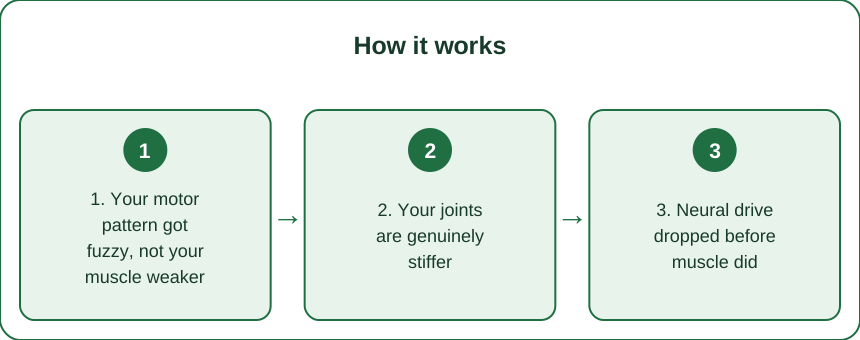
7. You came back at the wrong load — and 8. your expectations did the rest
The last two, and together they turn a two-session issue into a two-month slump.
7. The load was wrong
People return at the weight they left at. It’s a reasonable instinct and it produces a session that confirms the fear, because coordination and bracing aren’t ready even though the muscle is.
Return at roughly 80–85% of your pre-break working weight for the first session, focusing on clean patterning. Most people are back to full load by the second or third session.
The cost of returning too heavy isn’t just a bad session. It’s an elevated injury risk on rusty patterning, and it’s the psychological hit of a failed set that colors the next two weeks.
The cost of returning too light is nothing at all. The asymmetry here is enormous and people consistently choose the wrong side of it.
8. Your expectations are doing most of the work
Perceived exertion is heavily influenced by expectation. If you come back braced for weakness, the same weight feels heavier — this is a well-documented effect, not a motivational cliché.
One bad session becomes a story. “I lost my progress” leads to hesitancy, hesitancy produces genuinely worse sets, and the story becomes self-confirming.
A week off is also a week of recovery. Many people return with accumulated fatigue cleared and hit personal bests within two or three sessions — but only if they don’t spend those sessions cautiously.
Give it three sessions before drawing any conclusion. The pattern re-sharpens, the joints loosen, the brace returns, and almost everyone finds they were exactly where they left off.
When it isn’t just rust: sharp pain, a specific joint that feels unstable, or persistent weakness beyond three or four sessions is worth a professional opinion. This is general information, not medical advice.
TL;DR:
- Measurable strength loss takes two to three weeks off; one week does not cause it
- What actually changed: motor pattern sharpness, joint stiffness, neural drive, glycogen and water
- Bracing is the most perishable component and the one that most affects how heavy a load feels
- Return at 80–85% of your working weight and rebuild the pattern before the load
- Check shoes, bar, room temperature, and time of day before blaming physiology
- Expectation raises perceived exertion — give it three sessions before concluding anything
Your squat didn’t leave in a week. The coordination got fuzzy, and coordination comes back in two sessions.
See It in Motion
Seen here: Super High Waist Embossed Yoga Leggings with Inner Pocket — shop it on bubblelime.com
Keep Reading
This article is for general informational and styling purposes only. Fit, sizing, and product availability may vary.