7 Things That Change in Your Squat When the Gym Gets Crowded Again
Quick Answer: A crowded gym changes your squat in seven measurable ways: rest periods shrink, warm-up sets get skipped, setup gets rushed, depth gets shallower, bar path drifts under observation, equipment substitutions change the movement, and session structure gets reordered. None of these are strength problems, and all seven are fixable by changing your plan rather than your effort. The most costly single one is the rushed setup - it produces the majority of crowded-gym form breakdown.
Here is each one and the specific fix.

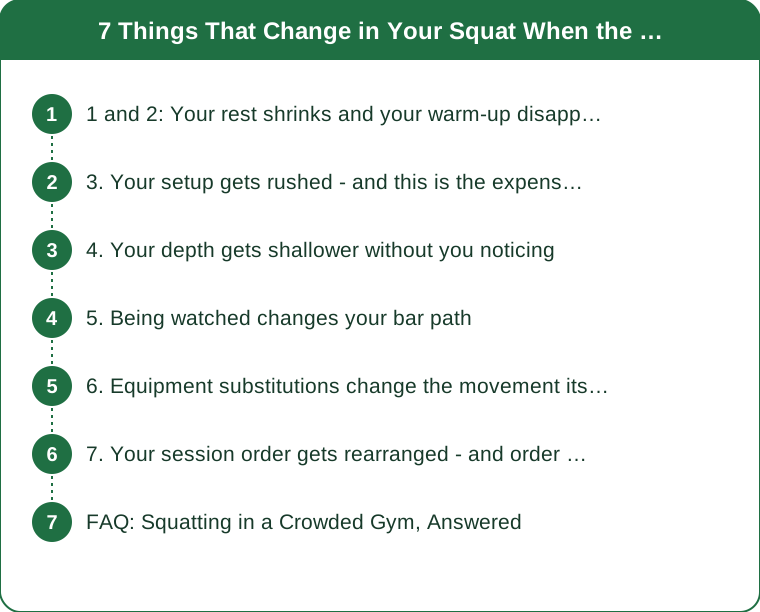
1 and 2: Your rest shrinks and your warm-up disappears
1. Your rest periods quietly get shorter
Someone standing near your rack applies real time pressure, and most people respond by cutting rest from three minutes to ninety seconds without deciding to.
Shortened rest does not make you stronger - it makes the same weight heavier. Phosphocreatine resynthesis for a heavy compound set takes around three minutes, and cutting that in half can drop your top-end capacity by ten to twenty percent on later sets.
The result is a session that feels harder and produces less. You grind reps, form degrades on set four, and you conclude you had a bad day when in fact you had a short-rest day.
The fix is to time rest with a timer rather than by feel. A visible countdown on your phone removes the social negotiation entirely - you are not deciding when to go, the timer is.
If the pressure is genuinely unworkable, offer to work in. Alternating sets restores your rest interval and costs you nothing but the time to change plates.
2. You skip warm-up sets to hold the rack
Warm-up sets are the first thing sacrificed when a rack is contested, because they feel optional and the working sets do not.
They are not optional. Warm-up sets do three separate jobs: they raise tissue temperature, they rehearse the exact bar path you are about to load, and they tell you what kind of day your body is having.
Skipping them makes the first working set the warm-up. That is the set where depth is shallowest and bracing is weakest, and it is being done at the heaviest load of the session.
The fix is to warm up away from the rack. Bodyweight squats, goblet squats with a light dumbbell, and hip work can all happen in a corner while you wait, so you arrive at the bar already prepared.
Then compress the barbell ramp rather than deleting it. Two ramp sets instead of four is a reasonable compromise; zero is not, and the difference in rack time is about ninety seconds.
3. Your setup gets rushed - and this is the expensive one
Setup is walking out the bar, placing the feet, taking the brace, and finding the position - and it takes maybe fifteen seconds when done properly.
Under observation, most people cut it to five. The bar comes out, the feet land approximately, and the descent starts before the brace is complete. Every downstream form problem begins here.
An incomplete brace is the specific failure. Bracing is a deliberate action - breathe into the belly, expand against the belt or the trunk, then descend. Rushed, it becomes a half breath into the chest, which supports far less.
Foot placement errors compound across the set. Feet a couple of centimetres off your normal stance change hip mechanics, and you spend the whole set fighting a position you chose in a hurry.
The fix is a fixed pre-set routine you always do. Same number of steps back, same breath, same count. A routine is faster than deciding, and it is immune to the person waiting behind you.
Give yourself permission to take the fifteen seconds. Nobody has ever actually objected to a proper setup, and the imagined pressure costs far more than the real one.
4. Your depth gets shallower without you noticing
Depth is the first thing to go when a squat feels rushed or watched, and it happens below conscious awareness - which is why people are surprised by video.
Shallow squats feel identical to deep ones from the inside. Proprioception at the bottom of a squat is genuinely poor, so the only reliable feedback is external - a mirror, a phone, a training partner, or a box.
Fatigue from short rest accelerates it. Each successive set loses a little depth, so set five is often noticeably higher than set one despite feeling harder.
The fix is an external reference for at least one set per session. Film a single set from the side each week. You do not need to film everything - one set tells you whether the trend is drifting.
Or squat to a consistent target. A box or a bench at your normal depth converts an invisible standard into a physical one that crowding cannot erode.

5. Being watched changes your bar path
People move differently when they believe they are observed - generally faster, more upright, and with less patience at the bottom.
The common change is an early hip rise. Wanting to look strong out of the hole produces a hip shoot that turns the squat into a good morning, loading the lower back rather than the legs.
Tempo speeds up on the descent too. A controlled two-second descent becomes a one-second drop, which reduces control at the exact point where control matters most.
Neither is a strength issue. Both are performance-under-observation effects, and both disappear the moment attention is redirected inward.
The fix is a single internal cue per set. Pick one thing - knees out, chest through, drive the floor away - and give the set your attention rather than the room.
Facing away from the busiest part of the gym helps more than it should. If your rack has a choice of orientation, take the one that gives you a wall.
6. Equipment substitutions change the movement itself
When racks are full, people substitute - and substitutions are not neutral. A hack squat, a leg press, and a Smith machine squat are different exercises, not the same exercise on different equipment.
The Smith machine is the most common swap and the least equivalent. The fixed bar path removes the stabilising demand entirely, so the load numbers are not comparable and carrying them back to a free bar goes badly.
Goblet and dumbbell squats are the best free-weight substitute because they preserve the movement pattern and the bracing demand, even though the load ceiling is lower.
Split squats and Bulgarians are the underrated answer. They need a bench and about two square metres, both of which exist even in a full gym, and they load each leg heavily with light dumbbells.
The fix is deciding your substitution in advance. Write a plan B into the program - so that when the rack is taken you execute a decision rather than improvise one while standing in the middle of the floor.
And log substitutions clearly. Six weeks of unlogged swaps makes your training history unreadable, and unreadable history is how plateaus become mysterious.
7. Your session order gets rearranged - and order matters
Crowding pushes people to do whatever is free, which frequently means squatting after accessory work rather than before.
Squatting late in a session costs you meaningful load. Pre-fatigued legs and a pre-fatigued trunk mean the same weight moves worse, and the first heavy set is now the tenth exercise of the day.
The compound-first principle exists for a reason. The most technically demanding, highest-load movement should meet the freshest version of you, both for output and for safety.
If squats have to move later, reduce the load target for that session. Trying to hit the same numbers on tired legs is how form breakdown turns into injury. Ninety percent of the planned load is the sensible adjustment.
The better fix is timing. Even shifting your session by 45 minutes - earlier in the morning or after the post-work peak - typically halves the wait for a rack in September.
And a temporary program change beats a degraded permanent one. If your gym is genuinely unusable for barbell squats for six weeks, a block of dumbbell and unilateral work is a legitimate plan, not a compromise.
One general note: knee or back pain that appears during this kind of transition and persists is worth having assessed properly rather than trained through. This is general information, not medical advice.
FAQ: Squatting in a Crowded Gym, Answered
What is the single most damaging effect of a crowded gym?
The rushed setup. Cutting the walk-out, foot placement, and brace from fifteen seconds to five produces most of the form breakdown people blame on fatigue or strength.
How short can rest periods get before it costs me?
Heavy compound sets want around three minutes for full phosphocreatine resynthesis. Cutting to ninety seconds can reduce top-end capacity by ten to twenty percent on later sets.
Is the Smith machine an acceptable squat substitute?
As a different exercise, yes. As an equivalent, no - the fixed bar path removes stabilising demand, so the loads do not transfer back to a free barbell.
What is the best substitute when every rack is taken?
Split squats or Bulgarian split squats. They need a bench and two square metres, preserve the movement pattern, and load each leg heavily with modest dumbbells.
Why does my depth get worse when the gym is busy?
Proprioception at the bottom of a squat is poor, so shallow feels identical to deep. Rushing and short rest both erode depth invisibly. Film one set from the side each week.
Should I still squat if it has to be at the end of the session?
Yes, but reduce the load to about ninety percent of plan. Pre-fatigued legs and trunk make the same weight riskier, not just harder.
Is it worth changing my training time?
Usually the highest-value fix available. Shifting 45 minutes either side of the post-work peak typically halves rack waiting time during the September rush.
TL;DR:
- Rest shrinks first. Use a visible timer so the decision is not social. Heavy sets want around three minutes.
- Warm up away from the rack - bodyweight and goblet work while you wait, then a compressed barbell ramp.
- Protect the setup. Fifteen seconds of walk-out, feet, and brace is where most crowded-gym form breakdown is prevented.
- Depth erodes invisibly. Film one set from the side weekly, or squat to a physical target.
- Being watched produces early hip rise and a faster descent. One internal cue per set fixes both.
- Decide your substitution in advance. Split squats beat the Smith machine for transfer.
- Squatting late costs load - drop to about 90% of plan if the order has to change.
Shifting your session 45 minutes off the post-work peak usually halves the wait. Persistent knee or back pain through a transition like this deserves proper assessment - this is general information, not medical advice.
See It in Motion
Seen here: High Waist Embossed Yoga Leggings with Side Pockets — shop it on bubblelime.com
Keep Reading
This article is for general informational and styling purposes only. Fit, sizing, and product availability may vary.