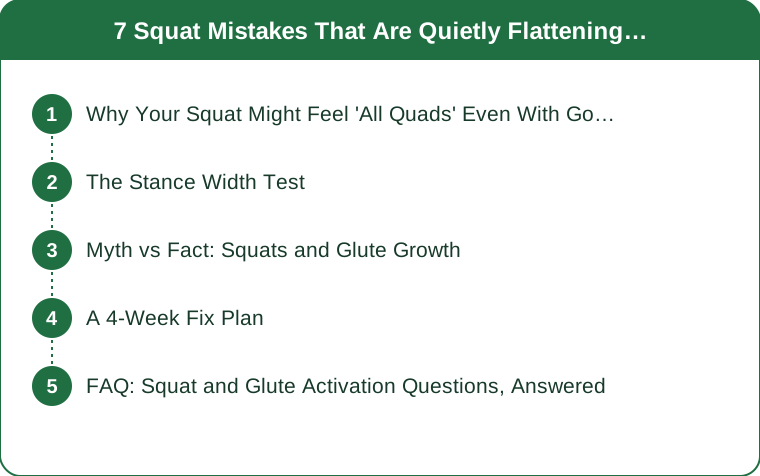
7 Squat Mistakes That Are Quietly Flattening Your Glutes
Quick Answer: Most squats that ‘don’t work’ are quad-dominant because of foot position, depth, or bar path — not because glutes need more isolation work. Fix these seven mechanics before adding volume.
You’ve squatted for months and your quads are on fire every session, but your glutes barely feel it the next day. That’s not bad genetics — it’s almost always one of these seven fixable habits.
-
Feet too narrow. A narrow stance biases the quads by shortening the range your hips travel through. Widen to just outside shoulder width and turn toes out 15-20 degrees to let the hips do more work.
-
Cutting depth short. Glute activation increases sharply below parallel — stopping at a quarter squat leaves most of the glute’s range untouched. Work toward hip crease below knee level if mobility allows.
-
Knees caving inward. When knees track inward, the glute medius disengages and the adductors take over. Actively push knees out over your toes on the way up.
-
Bar path drifting forward. If the bar drifts toward your toes instead of staying over mid-foot, your torso pitches forward and quads absorb the load. Keep the bar path a straight vertical line.
-
Rushing the eccentric. Dropping fast into the hole skips the controlled lengthening that recruits glute fibers. Take 2-3 seconds on the way down.
-
No pause at the bottom. A brief pause at depth removes the elastic bounce that lets quads do the work for you, forcing the glutes to initiate the drive up.
-
Skipping the squeeze at the top. Standing up without a deliberate glute squeeze leaves the last 10-15 degrees of hip extension — the part that finishes glute activation — half-done.

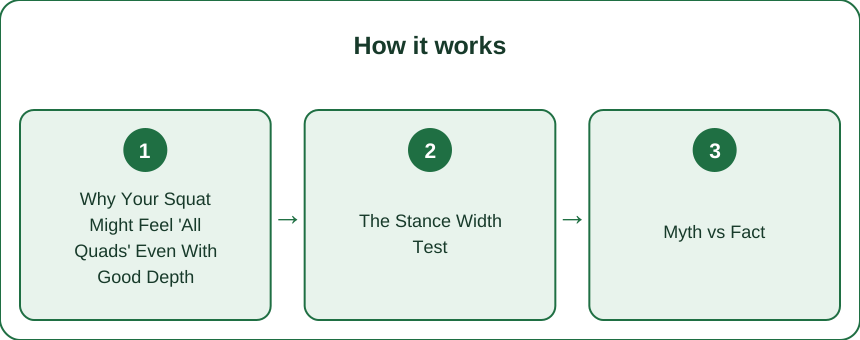
Why Your Squat Might Feel ‘All Quads’ Even With Good Depth
Depth alone doesn’t guarantee glute involvement if your stance and bar path are still quad-biased. Stance width and bar path do more work than depth in determining which muscle group dominates a squat — a deep squat with narrow feet and a forward-drifting bar is still mostly quads.
Try filming yourself from the side. If your shins travel far past your toes and the bar drifts forward, that’s a strong signal your setup is defaulting to a quad-dominant pattern regardless of how low you go.
The Stance Width Test
Stand with feet just outside shoulder width, toes turned out 15-20 degrees, and squat to depth without weight. If your hips feel more engaged than your last training squat, your working stance is too narrow.
Most people need a wider stance than feels natural at first — a stance that looks ‘too wide’ in the mirror is often exactly where glute engagement improves. Give it 2-3 sessions before judging; unfamiliar stances feel awkward before they feel strong.

Myth vs Fact: Squats and Glute Growth
Myth: Any squat variation builds glutes equally. Fact: front squats and high-bar squats are meaningfully more quad-dominant than low-bar back squats or box squats, which shift more load to the hips.
Myth: You need to feel it burning to know it’s working. Fact: glute activation and next-day soreness aren’t the same thing — a well-executed squat can build strength without a dramatic burn.
Myth: Adding weight fixes weak glute engagement. Fact: heavier weight on a broken pattern just reinforces the same compensation, usually the quads, more forcefully.
A 4-Week Fix Plan
Week 1-2: Drop to 60% of your working weight and rebuild stance, depth, and pause at the bottom for 3 sets of 8. Week 3: Add the deliberate top-of-rep glute squeeze and reintroduce 75% of working weight. Week 4: Return to full working weight with all seven fixes as default form, not conscious effort.
This isn’t a step backward — cleaning up mechanics at lighter weight for two weeks typically adds more long-term glute development than months of heavy squats on a flawed pattern.
FAQ: Squat and Glute Activation Questions, Answered
Should I add hip thrusts if my squat isn’t hitting glutes?
Hip thrusts are a good supplement, but fixing squat mechanics first means your heaviest, most frequent lift finally contributes to the goal instead of working around it.
How do I know if my depth is actually below parallel?
Have someone check from the side, or film yourself — the hip crease should dip visibly below the top of the knee at the bottom of the rep.
Is a wider stance bad for my knees?
A wider stance with proper toe-out generally reduces knee stress compared to a narrow stance with caving knees, as long as knees track over toes throughout.
TL;DR:
- Narrow stance, shallow depth, and forward bar drift are the biggest glute-killers
- Widen your stance, turn toes out 15-20 degrees, and control the eccentric
- Add a pause at depth and a deliberate squeeze at the top
- Give a stance change 2-3 sessions before judging results
Fixing these seven habits usually does more for glute development than any amount of added weight on a broken pattern.
See It in Motion
Seen here: Super High Waist Embossed Yoga Leggings with Inner Pocket — shop it on bubblelime.com
Keep Reading
This article is for general informational and styling purposes only. Fit, sizing, and product availability may vary.