7 Squat Cues That Work Better Than Keep Your Chest Up
Quick Answer: Chest up is vague, and the most common way people execute it is by extending the lower back, which shifts load onto the spine and blocks hip depth. Better cues are external and specific — they describe an outcome in the world rather than a body part to move, and motor learning research consistently finds external cues produce better performance and faster learning. These seven give you something concrete to do at a specific moment.
One cue at a time, for a full session. Not seven at once.

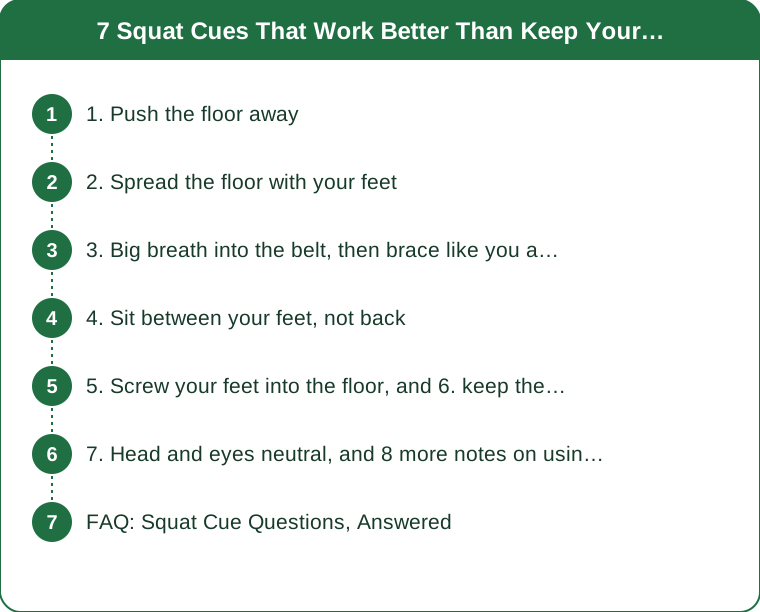
1. Push the floor away
The most useful single replacement for chest up, and it fixes several things at once.
Instead of thinking about standing up, think about driving the floor down and away from you. Same movement, entirely different organisation.
Why it works better: it is an external cue, meaning it directs attention to an effect in the environment rather than to a body part. Motor learning research has repeatedly found that external focus produces better force output, better movement quality, and faster learning than internal focus on body segments.
What it fixes in practice: it encourages full foot pressure rather than pushing from the toes, it prompts a simultaneous drive rather than the hips shooting up first, and it removes the tendency to think your way up segment by segment.
Use it on the ascent, from the bottom position. Most people find it changes how the first six inches out of the hole feel immediately.
If you take one cue from this list, take this one.
2. Spread the floor with your feet
The fix for knees collapsing inward, and it works when knees out does not.
Imagine you are standing on a mat and trying to tear it apart sideways — pressure outward through the outside edges of both feet, without the feet actually moving.
Why it works better than knees out: knees out is an internal cue about a joint, and people typically overdo it, forcing the knees wide and rolling to the outside edges of the feet, which is its own problem. Spreading the floor generates the same external rotation through the hips while keeping the whole foot loaded.
What it fixes: knee valgus, which is the inward collapse that appears under load or during fatigue, and it also creates genuine tension in the hips before you descend.
Apply it at the top, before you start moving, and maintain it throughout. It is a setup cue as much as a movement one.
3. Big breath into the belt, then brace like you are about to be punched
The trunk cue that actually produces stability, rather than the vague instruction to keep your core tight.
Take a large breath into the abdomen, not the chest, then tense the entire trunk as if bracing for impact. The breath goes in low, the ribs stay down, and the whole cylinder becomes rigid.
Why it works better than chest up: chest up encourages the ribs to flare upward, which puts the spine into extension and disconnects the abdominal wall. A braced trunk with the ribs stacked over the pelvis is what actually protects the back and transmits force.
What it fixes: excessive lumbar extension, the loss of position under heavier loads, and the common experience of the lower back doing the work.
Take the breath at the top, hold through the descent and the drive, and breathe at the top between reps. This is the Valsalva approach used in strength training, and it is standard practice under load — though if you have high blood pressure, a cardiovascular condition, or are pregnant, this is exactly the kind of thing to discuss with your doctor before using it.

4. Sit between your feet, not back
The depth cue, and the correction for anyone stuck in a good morning pattern.
Think of lowering yourself down between your feet, rather than sitting back onto a chair behind you.
Why it works: sit back is a useful cue for a low bar squat and a powerlifting stance, and it is frequently misapplied. For most people squatting for general strength, sitting back excessively produces a forward lean, more hip and back load, and less depth.
What it fixes: the hips travelling backward faster than they travel down, which is the root cause of both a forward torso angle and the hips shooting up early on the ascent.
Use it on the descent. Most people find they get more depth immediately, with less lean, and it feels considerably less like a hinge and more like a squat.
5. Screw your feet into the floor, and 6. keep the bar over midfoot
5. Screw your feet into the floor
The setup cue that stabilises the whole chain before you move, and it takes two seconds.
Stand in position and, without moving your feet, apply a rotational pressure as though screwing them outward into the ground.
Why it works: it creates torque through the hips and generates tension all the way up the chain before the descent begins. A squat that starts from a tense, organised position is a completely different movement from one that starts loose, and most technique problems in the bottom are actually setup problems.
What it fixes: unstable feet, arches collapsing, and the loss of position in the bottom third.
Apply it during the setup, before you unrack or before your first rep. It should be the last thing you do before you descend.
6. Keep the bar over midfoot, all the way down
The balance cue, and the one that explains most failed reps.
Keep the loaded bar tracking directly over the middle of your foot throughout the movement, rather than drifting forward over the toes or back toward the heels.
Why it works: midfoot is where the system is balanced, and any drift forward increases the moment arm on the lower back dramatically. A rep that fails almost always failed because the bar moved forward first.
What it fixes: forward drift, heels lifting, and the sensation of being pulled forward out of the bottom.
Use it as a check rather than a constant thought. Film one set from the side and watch the bar path — it is the single most informative thing you can do for your squat, and most people have never looked.
7. Head and eyes neutral, and 8 more notes on using cues well
7. Keep your head neutral and look at a fixed point ahead
Look at a point on the floor several feet in front of you, or straight ahead, and keep your neck in line with your spine.
Why it works: looking sharply upward extends the neck, which encourages the lumbar extension that chest up already causes, and looking down at your feet tends to pull the whole torso forward. Neutral keeps the spine stacked.
What it fixes: neck strain, the tendency to lead with the head, and inconsistent bar path.
How to actually use these
Use one cue per session. This is the part everyone gets wrong. Attention is limited, and trying to hold seven cues at once means executing none of them. Pick one, use it for every set for a week, and let it become automatic before adding another.
Prefer external cues. Push the floor away, spread the floor, screw the feet in. These consistently outperform internal cues about muscles and joints in the research on motor learning.
Film yourself from the side. You cannot feel what you look like, and one video answers more questions than a month of self assessment in a mirror. Mirrors also encourage a head position that is not neutral.
Fix one thing at a time and re film. Squat technique problems are usually connected, and correcting the earliest one in the chain often resolves two others without further work.
Warm up more as the weather cools. Cold hips and ankles reduce mobility measurably, and a squat session in a cold autumn gym needs a longer warm up than the same session in August. Depth that disappears in October is often temperature rather than a technique regression.
This is general training information. If you have pain during squatting, a history of back or knee injury, or any condition affected by heavy lifting, work with a coach or physiotherapist who can watch you move rather than following general cues.
FAQ: Squat Cue Questions, Answered
What is wrong with chest up?
Nothing in principle, and a lot in practice. Most people execute it by extending the lower back and flaring the ribs, which loads the spine, disconnects the brace, and limits depth. It also gives no information about what to do with the rest of your body.
How many cues should I use at once?
One. Attention is a limited resource, and holding several cues means executing none of them well. Use one for a full week of sessions, then move on.
Why are external cues better?
Because the research on motor learning consistently finds that focusing on an effect in the environment produces better force output and faster learning than focusing on body parts. It also stops you overthinking a movement you already partly know.
Why has my squat depth got worse recently?
If nothing else has changed, check temperature and warm up first. Cold hips and ankles reduce available range, and autumn sessions in a cold gym genuinely lose depth that a longer warm up restores.
TL;DR:
- Chest up is vague and usually executed as lower back extension, which loads the spine and limits depth.
- External cues — push the floor away, spread the floor, screw your feet in — outperform internal ones in both output and learning.
- Brace by breathing low and tensing the whole trunk with ribs down, rather than lifting the chest.
- Use one cue per session, film from the side, and warm up longer as gyms get colder.
Pick push the floor away and use only that for a week. It fixes more than the other six combined.
See It in Motion
Seen here: Super High Waist Embossed Yoga Leggings with Inner Pocket — shop it on bubblelime.com
Keep Reading
This article is for general informational and styling purposes only. Fit, sizing, and product availability may vary.