7 Squat Cues That Work Better Than Chest Up
Quick Answer: ‘Chest up’ is a cue about appearance rather than about the mechanics that make a squat work. Taken literally it produces excessive lumbar extension, rib flare, and a loss of bracing — which is why people who follow it diligently often develop lower back complaints. The seven cues below target the actual mechanics: bracing, foot pressure, hip movement and bar path.
Someone told you to keep your chest up, you did, and your lower back started aching within a month.
The cue is not wrong exactly. It is a description of what a good squat looks like, being used as an instruction for how to do one, and those are different things.
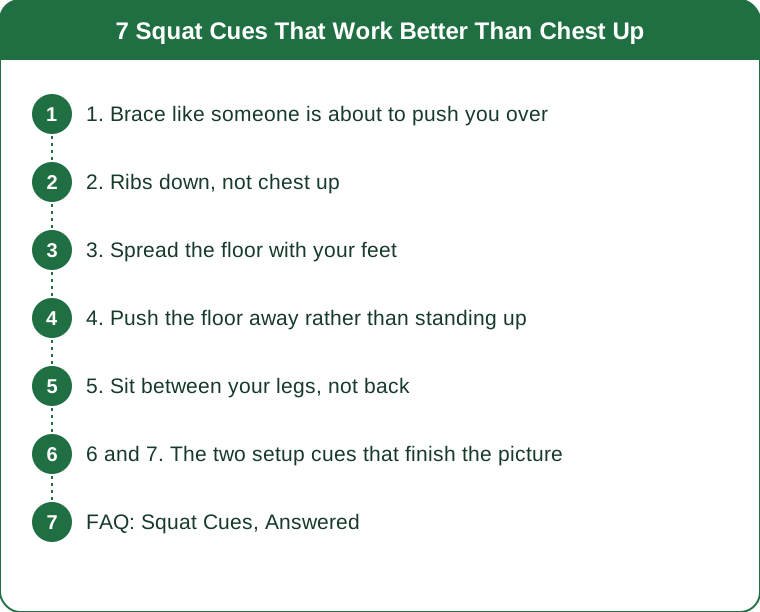
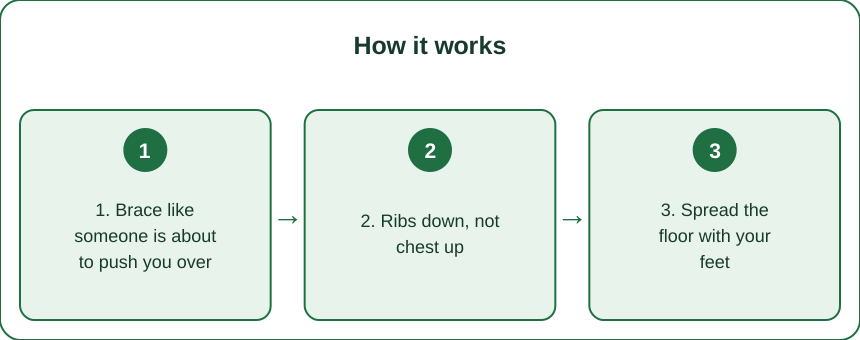
1. Brace like someone is about to push you over
The most important cue in the list, and the one most often missing entirely.
A squat is held together by intra-abdominal pressure — a stiff, pressurised trunk that transmits force between your legs and the bar. Without it, the load finds the path of least resistance, which is usually your lower back.
‘Chest up’ actively works against this. Lifting the chest tends to flare the ribs upward, which lengthens the abdominal wall and makes a proper brace much harder to achieve. You end up looking upright and being structurally soft.
The cue that works: take a breath into your stomach rather than your chest, then brace as though you are about to be pushed sideways. Not sucking in, not pushing out — tensing in all directions at once.
Check it by placing a hand on your side at the waist. You should feel it expand outward when you breathe in, and stay firm when you brace. If your shoulders rise when you breathe, you are breathing into the wrong place.
Hold the brace for the whole repetition. Breathe at the top, between reps, not at the bottom.
2. Ribs down, not chest up
The direct correction, and often all somebody needs.
Rib flare is what happens when the front of the ribcage lifts away from the pelvis. It creates the appearance of an upright torso by extending the lumbar spine rather than by improving position, and it puts the lower back into a position it cannot brace from.
The cue: think about the bottom of your ribcage moving down toward your pelvis, and keeping it there. Some coaches use ‘close the space between your ribs and your hips’.
Combined with a proper brace, this produces a genuinely stable trunk that can maintain position under load rather than one that looks correct while standing still.
A useful self-check at the top of a rep: with a hand on your sternum and a hand on your pubic bone, those two points should stay roughly the same distance apart throughout. If the distance opens at the bottom of the squat, the ribs are flaring.
This single change resolves a large proportion of squat-related lower back discomfort, which is worth knowing before spending money on mobility work that does not address it.
3. Spread the floor with your feet
A cue that fixes knee position without anyone having to think about knees.
Knees caving inward is one of the most common squat faults, and telling someone to push their knees out produces a rigid, deliberate movement that rarely transfers.
‘Spread the floor’ — attempting to push the floor apart with your feet without actually moving them — engages the glutes and external rotators, and the knees track correctly as a consequence. It is an intent rather than a position, and intent-based cues transfer far better.
Set it before you descend, from the moment you unrack, and maintain it throughout.
This also improves foot stability. Spreading the floor naturally produces a tripod foot position — pressure through the big toe, little toe and heel — which is a more stable base than either rolling inward or gripping with the toes.
If the knees still cave under heavier loads despite the cue, that is usually a strength issue in the glutes rather than a technique issue, and it responds to direct work rather than to better cueing.
4. Push the floor away rather than standing up
A change in intent that improves almost everyone’s drive out of the bottom.
‘Stand up’ directs attention to your torso, which encourages the hips to rise first — the classic good-morning fault where the hips shoot up and the bar path drifts forward.
‘Push the floor away’ directs attention to your feet and to leg drive. The whole system rises together, the torso angle stays consistent, and the bar travels vertically.
Vertical bar path is the actual technical objective in a squat, and most faults are ultimately deviations from it. Cues that produce a vertical bar path are better than cues that produce a particular appearance.
A related cue that works well for people whose hips rise first: ‘keep your chest and hips rising at the same speed’. It is not literally about the chest position, but about the relationship between two things moving together.
For anyone who gets stuck just above parallel, adding ‘drive your upper back into the bar’ at the same moment helps — it maintains the connection between bar and body during the hardest part of the lift.
5. Sit between your legs, not back
A correction to another over-applied cue.
‘Sit back’ is useful for people who dive forward with their knees, and it is applied far more broadly than it should be. Taken too far it produces an excessively hip-dominant squat with a forward-leaning torso — which is a good morning with a bend in the knees.
For most people squatting for general strength, ‘sit between your legs’ produces better depth and a more balanced load distribution. The hips travel down between the feet rather than backward, the knees are allowed to travel forward over the toes, and the torso stays more upright naturally — without anyone having to think about their chest.
Knees travelling forward over the toes is normal and safe for most people. The idea that they should not is one of the more persistent pieces of gym folklore, and it produces squats that load the lower back to protect knees that were never at risk.
Stance width interacts with this. A slightly wider stance with feet turned out 15-30 degrees makes ‘sit between your legs’ much easier to achieve, and suits most people better than a narrow stance.
6 and 7. The two setup cues that finish the picture
6. Screw your feet into the floor
A refinement of the spreading cue that adds stability at the ankle and hip.
The intent is to rotate your feet outward against the floor without them moving — as though standing on two plates and trying to turn them apart.
This creates torque through the hip, which stabilises the joint and improves the position of the femur in the socket. Practically, people report feeling more stable and finding depth easier without any change in mobility.
It also fixes the collapsed arch problem. Feet that roll inward under load take the knee with them, and a foot actively screwing outward maintains the arch without any conscious thought about foot position.
Apply it at setup and maintain it through the lift. Losing it at the bottom is common and is often what people experience as feeling unstable in the hole.
Barefoot or in flat-soled shoes this is much easier to feel. In heavily cushioned running shoes it is nearly impossible, which is one of several reasons running shoes are a poor choice for squatting.
7. Look at a fixed point straight ahead
The replacement for the head-position half of ‘chest up’.
Looking up is commonly taught and creates neck extension, which encourages the whole lumbar chain to extend with it and works against the ribs-down position. Looking down tends to pull the torso forward.
A fixed point straight ahead, or very slightly down, keeps the neck in a neutral position and gives you a stable visual reference. Some strong lifters prefer looking down and slightly forward; almost nobody who lifts well looks up.
Choose the point before you unrack and keep your eyes on it for the whole set. Head movement mid-rep is a surprisingly common source of instability.
A note on applying all seven: do not. Pick one, work on it for a few sessions until it stops requiring attention, then add another. Cue overload produces worse lifting than no cue at all, because conscious attention to multiple things simultaneously degrades a movement pattern.
The usual priority order is bracing first, then ribs down, then foot pressure, then everything else. Most people who fix the first two find several of the others resolve without direct attention. This is general information, not medical advice — if you have back or knee pain, get assessed rather than cueing your way around it.
FAQ: Squat Cues, Answered
Is ‘chest up’ always wrong?
No — for someone whose torso collapses forward badly, it can be exactly the right cue in the moment. The problem is that it is given universally rather than selectively, and that people who already have adequate torso position take it further and end up in excessive extension. Cues are corrections for specific faults, not universal rules.
How do I know which cue I need?
Film a set from the side. Hips rising faster than the shoulders means cue 4. Ribs visibly flaring or the lower back arching hard at the bottom means cue 2. Knees caving means cue 3 or 6. Excessive forward lean with the bar drifting over the toes means cue 5. One recording answers this faster than any amount of feeling.
Should the cue change as the weight gets heavier?
The cues stay the same; the priority shifts. At heavy loads bracing becomes the dominant cue and everything else should already be automatic. If you are still consciously thinking about foot position at 90% of your maximum, the weight is ahead of the technique.
TL;DR:
- ‘Chest up’ describes what a squat looks like rather than instructing what makes it work, and it commonly produces rib flare and lumbar extension.
- Brace as though someone is about to push you over, and keep the ribs down toward the pelvis — these two fix most problems.
- ‘Spread the floor’ and ‘screw your feet into the floor’ fix knee tracking without anyone thinking about knees.
- ‘Push the floor away’ produces a vertical bar path; ‘sit between your legs’ beats ‘sit back’ for most people.
- Use one cue at a time until it becomes automatic — cue overload lifts worse than no cue at all.
The reason this matters beyond pedantry is that a cue given to the wrong person creates the fault it was meant to prevent. Someone with a perfectly adequate torso position who is told to lift their chest ends up bracing worse and loading their lower back more, which is a strange outcome for the most common piece of advice in any gym.
See It in Motion
Seen here: Bootcut Capri Yoga Pants with Pockets — shop similar styles on bubblelime.com
Keep Reading
This article is for general informational and styling purposes only. Fit, sizing, and product availability may vary.