7 Signs You're Actually Ready to Add Weight to Your Squat
Quick Answer: You’re ready to add weight when you can hit full depth with a neutral spine for multiple consistent reps, control the descent instead of dropping into the bottom, and your knees track over your toes without collapsing inward — consistently, not just occasionally.
The eagerness to add plates usually arrives well before the form actually supports it. Here are seven concrete signs — not vibes, actual checkpoints — that your squat is ready for load, along with what to do about it if you’re not quite there yet on one or two of them.

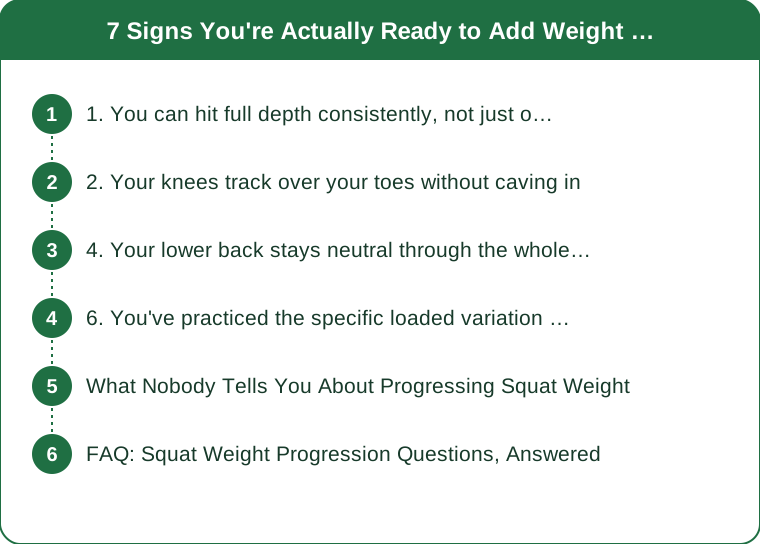
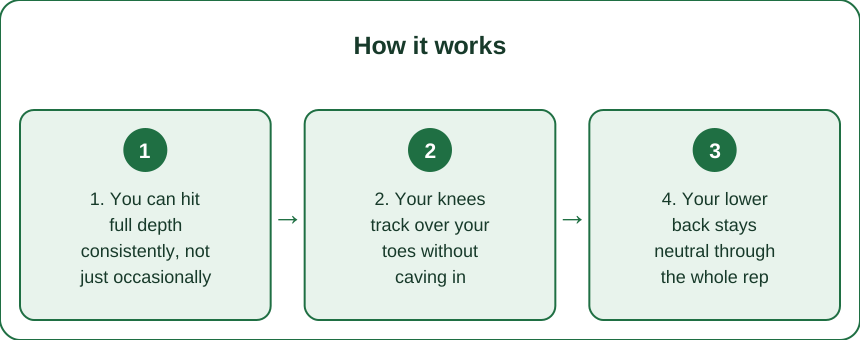
1. You can hit full depth consistently, not just occasionally
Full depth (hip crease below knee level, for those without a mobility limitation preventing it) should be achievable on most reps of a working set, not just your best single rep when you’re paying extra attention. If depth varies wildly rep to rep, adding weight will only make the inconsistent reps worse, not better.
A useful test: do a set of 10 bodyweight squats without stopping to reset between reps, and check whether depth on rep 8 or 9 still matches rep 1. If fatigue is already eating into your depth by the end of a short bodyweight set, external load will make that drop-off happen even sooner.
2. Your knees track over your toes without caving in
Knee valgus — the knees collapsing inward during the squat, especially near the bottom — is one of the clearest signs the surrounding hip and glute muscles aren’t yet stabilizing the movement well enough for added load. Filming yourself from the front, not just the side, is often the only way to actually catch this, since it’s very hard to feel your own knees drifting inward in the moment.
3. You can control the descent instead of dropping into the bottom
A controlled 2-3 second descent shows you have eccentric control over the movement, not just the ability to fall into position and drive back up. Dropping quickly into the bottom position under load is a common way people develop knee or lower back irritation once weight gets added too early. Counting ‘1-2-3’ out loud on the way down during practice sets is a simple, low-tech way to build this pacing before it needs to hold up under a loaded bar.
4. Your lower back stays neutral through the whole rep
Rounding at the bottom (butt wink) or excessive arching are both signs your current mobility or core bracing isn’t quite ready to maintain a neutral spine through a full range of motion. This matters even more once a bar is loaded on your back, since spinal position under load carries more real consequence than it does bodyweight-only. If rounding only shows up at the very bottom of your deepest reps, that’s often a mobility limitation rather than a strength one, and worth addressing with ankle and hip mobility work before piling on weight.
5. You can brace your core and maintain it for the full set
A solid brace — pressure held evenly around your midsection, not just a sucked-in stomach — should hold through an entire set of reps, not just the first one or two before fatigue causes it to leak. Practicing a 360-degree breath, expanding into your sides and lower back as well as your stomach, tends to produce a noticeably more durable brace than only pulling your belly button in.

6. You’ve practiced the specific loaded variation you’re about to add
Goblet squats, front-loaded squats, and back-loaded barbell squats each shift your center of gravity slightly differently, so ‘ready to add weight’ should really mean ready for the specific loaded variation you’re about to try, not just squats in general. Jumping straight to a barbell back squat without ever trying a goblet squat first skips a genuinely useful intermediate step, since the goblet position naturally encourages a more upright torso and gives you immediate feedback if your balance shifts.
7. You have someone, or a mirror, checking your form objectively
Self-assessment under fatigue is notoriously unreliable — form that feels fine internally can look quite different from outside. A training partner, coach, or even a phone recording of your working sets gives you the objective check that pure self-feel can’t, and reviewing footage after a set, not just during it, often reveals issues you were too focused on the lift itself to notice in real time.
What Nobody Tells You About Progressing Squat Weight
Most people assume readiness is a single moment where everything clicks at once — in practice, it’s far more common to hit six of these seven signs solidly while one lags behind for weeks, and that’s completely normal rather than a sign something is wrong. The temptation is to add weight anyway once most boxes are checked, but the one lagging sign is usually exactly the one that breaks down first once real load gets added, so it’s worth the extra patience to bring it up to the same standard as the rest.
Another thing rarely mentioned: readiness can regress. A period of less frequent training, a minor injury elsewhere in the body, or even just a stressful week can quietly erode form that used to be solid. Reassessing these seven signs isn’t just a one-time gate before your first loaded set — it’s worth a quick mental check-in periodically throughout a training year, not only at the very beginning.
FAQ: Squat Weight Progression Questions, Answered
How many bodyweight reps should I be able to do before adding weight?
There’s no single universal number, but comfortably completing 15-20 clean bodyweight squat reps with consistent depth and control is a reasonable general benchmark before introducing external load.
Should I add weight gradually or wait until all 7 signs are fully checked off?
Gradually is generally safer — start with very light load (an empty bar, light dumbbells) once most of the signs are solidly in place, and keep assessing form as weight increases rather than treating this as a one-time pass/fail checkpoint.
What if I’ve been squatting with weight for a while but I’m now noticing some of these issues?
It’s worth temporarily deloading to address the specific breakdown (knee tracking, depth consistency, spinal position) before continuing to add more weight — fixing the issue now costs far less than continuing to reinforce it under increasing load.
Is it normal for some of these signs to come more easily than others?
Yes — depth and bracing often click before knee tracking and descent control do, since the latter two rely more on developed motor control than on strength or mobility alone, so uneven progress across the seven signs is completely typical.
TL;DR:
- Full depth needs to be consistent across most reps, not just your best one
- Knees tracking properly and a controlled descent both matter more than raw strength readiness
- A neutral spine and a solid core brace both need to hold for the entire set, not just the first rep
- Practice the specific loaded variation (goblet, front, back) before jumping straight to the heaviest option
- Get an objective form check — self-assessment under fatigue isn’t reliable
Adding weight should follow your form being ready, not the other way around — patience here saves you months of correcting bad habits later, and every one of these seven checkpoints is something you can actually work on this week, not just wait to develop on its own. This is general information, not medical advice.
See It in Motion
Seen here: High Waist Bootcut Yoga Pants with Pockets — shop it on bubblelime.com
Keep Reading
This article is for general informational and styling purposes only. Fit, sizing, and product availability may vary.