7 Signs Your Squat Stance Width Is Actually Wrong for Your Specific Hip Anatomy
Quick Answer: Your squat stance is likely mismatched to your hip anatomy if you consistently feel pinching at the front of the hip at depth, can’t reach a comfortable depth without your heels lifting, or your knees cave inward regardless of how much you cue yourself to push them out — these are anatomy-driven signals, not simply a strength or mobility problem to push through.

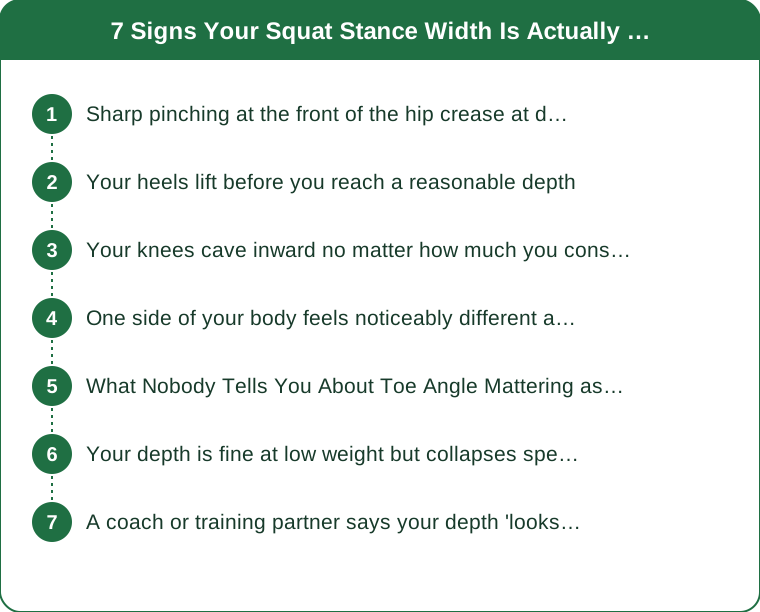
Sharp pinching at the front of the hip crease at depth
A stance too narrow for your specific hip socket anatomy (particularly hip socket depth and femur angle) often produces a pinching sensation right at the front hip crease as you approach depth — this is a structural bony impingement issue for many people, not a flexibility problem, meaning stretching more won’t fix it, but widening your stance and adjusting toe angle often resolves it immediately.
Your heels lift before you reach a reasonable depth
While ankle mobility is the more commonly blamed cause of early heel lift, stance width mismatched to hip structure can force compensations that show up as heel lift too — testing a slightly different stance width before assuming it’s purely an ankle mobility issue is worth doing, since some people fix apparent ‘ankle mobility’ problems simply by adjusting stance.
Your knees cave inward no matter how much you consciously push them out
Persistent knee cave despite conscious effort and cueing sometimes indicates the stance width is fighting your natural hip mechanics rather than being purely a glute activation weakness — for some hip structures, a wider stance with slightly more toe-out angle allows the knees to track naturally in line without requiring constant conscious correction.

One side of your body feels noticeably different at the same stance width
Hip anatomy isn’t always perfectly symmetrical, and a stance width that feels fine on one side while producing pinching or instability on the other suggests genuine anatomical asymmetry worth working around with a slightly individualized stance rather than forcing perfect bilateral symmetry that ignores real structural differences.
What Nobody Tells You About Toe Angle Mattering as Much as Stance Width
Stance width and toe-out angle work together, and adjusting only one while keeping the other fixed can mask whether the actual problem is width or angle — testing combinations (narrower stance with more toe-out, wider stance with less toe-out) systematically reveals which specific combination actually suits your hip anatomy, rather than assuming stance width alone is the single variable to fix.
Your depth is fine at low weight but collapses specifically as weight increases
If depth is genuinely achievable at bodyweight but consistently breaks down specifically under load at the same stance, this suggests the stance is marginal for your anatomy — technically workable but without much margin for error, meaning even small technique breakdowns under fatigue or load reveal the underlying mismatch that light-weight reps don’t expose.
A coach or training partner says your depth ‘looks’ fine but it doesn’t feel fine to you, plus FAQ: Squat Stance and Hip Anatomy
Trusting your own joint sensations over purely visual depth assessment matters here — a stance can produce visually acceptable depth while still creating internal hip discomfort that an outside observer can’t see, and that internal signal is often the more reliable indicator that something about your current stance doesn’t match your actual hip structure.
How do you actually test for the ‘right’ stance width systematically?
Trying a grid of a few stance widths and toe angles across several sessions, tracking which combination feels most pain-free and allows full depth most consistently, is more reliable than guessing from a single session.
Does hip anatomy mismatch mean someone should avoid back squats entirely?
Not necessarily — adjusting stance width and toe angle resolves the issue for many people; only in cases of significant structural limitation would switching to a different squat variation become the better long-term solution.
Can hip anatomy-related stance issues change over time with training?
The underlying bony anatomy itself doesn’t change, but surrounding mobility and strength can improve enough to expand the range of stances that feel comfortable, even if the ideal stance for your specific anatomy stays relatively consistent.
TL;DR:
- Hip pinching at depth and heel lift can both trace to stance width mismatched to your hip anatomy
- Persistent knee cave despite cueing sometimes reflects stance fighting natural hip mechanics
- Toe angle and stance width need testing together, not as separate isolated variables
- Depth collapsing specifically under load, not at bodyweight, reveals a marginal stance-anatomy fit
A stance that works for someone else’s hips isn’t automatically right for yours — testing systematically beats copying a cue that doesn’t account for individual anatomy.
See It in Motion
Seen here: High Waist Printed Bootcut Yoga Pants with Pockets — shop it on bubblelime.com
Keep Reading
This article is for general informational and styling purposes only. Fit, sizing, and product availability may vary.