7 Signs Your Squat Setup Is Wrong Before the Bar Even Moves
Quick Answer: Bad squats are usually decided in the 10 seconds before you unrack — stance width, bar position, and brace timing predict most failed reps before the bar ever moves. Fix the setup and the rep usually fixes itself.
You’ve drilled depth, you’ve drilled knee tracking, and the set still feels off from the first inch. That’s rarely a strength problem. It’s almost always something in your setup that got skipped because it felt like a formality. Here are the 7 tells that predict a bad set before it starts.

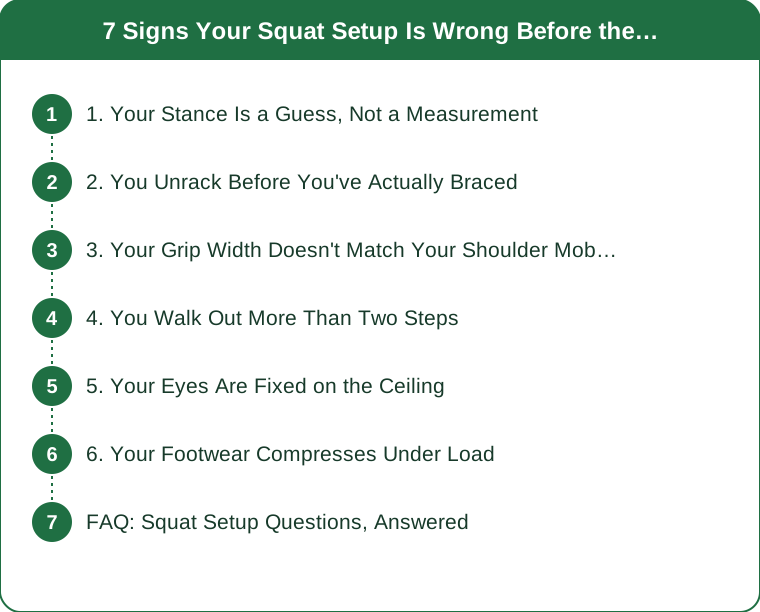
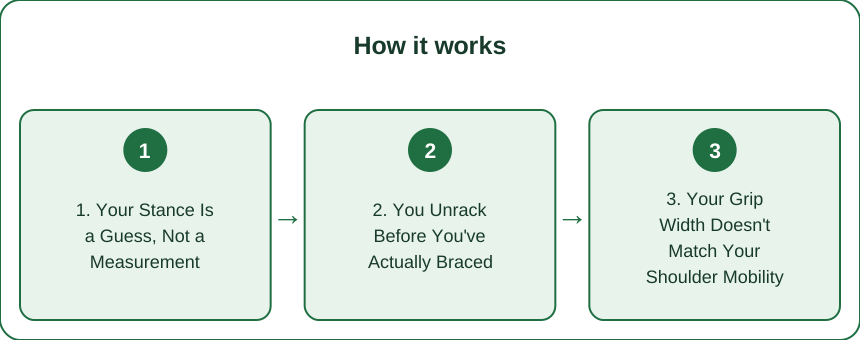
1. Your Stance Is a Guess, Not a Measurement
Most lifters set their stance by feel every single time, which means it changes slightly rep to rep. Pick a width once — heels roughly shoulder width, toes turned out about 15-20 degrees — and mark it. Chalk dots on the platform or a mental note of the rack’s power leg position work fine.
A stance that drifts an inch wider or narrower changes your hip angle enough to shift where the bar wants to travel, and that shows up as a wobble you can’t explain.
2. You Unrack Before You’ve Actually Braced
Bracing after the bar is already on your back means you’re fighting gravity and tightening at the same time. Take your big breath and 360-degree brace before your hands even touch the bar, then unrack already tight.
The tell: if your first thought after unracking is ‘okay, now brace,’ you’re one full step behind on every set.
3. Your Grip Width Doesn’t Match Your Shoulder Mobility
A grip that’s too narrow for your shoulder mobility forces your elbows down and your upper back to round slightly to compensate — and that rounding is invisible from the front but shows up as a forward lean the moment the weight gets heavy.
Test it: rack the empty bar, get your grip, and check if your elbows can stay roughly under the bar without shoulder pain. If not, walk the grip out an inch or two.

4. You Walk Out More Than Two Steps
Every extra step out of the rack is a chance to lose your brace and drift off your intended bar path. Two steps — one to clear the rack, one to set your stance — is the ceiling for most home and commercial setups.
If you’re taking three or four steps, move the safety pins or your rack position instead of walking further.
5. Your Eyes Are Fixed on the Ceiling
Looking straight up hyperextends the neck and pulls your upper back out of a neutral position, which tips the bar path forward as you descend. A slightly downward, fixed gaze point about 6-8 feet in front of you keeps your spine stacked and your bar path vertical.
Myth vs Fact: looking up does not help you stay upright — it does the opposite by cuing your chest to lift and your lower back to overextend.
6. Your Footwear Compresses Under Load
Running shoes have cushioned heels that compress unevenly left to right under a heavy bar, and that tiny wobble is enough to throw off your balance on a max-effort rep. Flat, hard-soled shoes — or barefoot on a stable surface — remove that variable entirely.
If your training shoes visibly compress when you press your heel into the floor, that’s your setup leak.
FAQ: Squat Setup Questions, Answered
How long should my squat setup actually take?
Aim for 5-8 seconds from grabbing the bar to your first descent. Faster than that and you’re skipping the brace; slower and you’re likely second-guessing a decision you should have made before you unracked.
Should I use the same setup for every squat variation?
Stance and grip shift for front squats, box squats, and safety-bar squats, but the brace-before-unrack sequence and the fixed gaze point stay constant across all of them.
Is it normal for setup to feel different on heavy days?
Somewhat — heavier bars feel different on your back — but your actual stance, grip, and brace timing shouldn’t change. If they do, that inconsistency is worth fixing before you add more weight.
TL;DR:
- Mark your stance once instead of guessing it every set
- Brace before you unrack, not after
- Match grip width to your actual shoulder mobility
- Limit your walkout to two steps and fix a downward gaze point
- Check that your shoes aren’t compressing unevenly under load
Run through these 7 before your next heavy day — most bad sets get fixed in the setup, not the descent.
See It in Motion
Seen here: High Waist 8” Yoga Shorts — shop similar styles on bubblelime.com
Keep Reading
This article is for general informational and styling purposes only. Fit, sizing, and product availability may vary.