7 Signs Your Squat Form Is Actually Wrong, Not Just Uncomfortable
Quick Answer: Knees caving inward, heels lifting, a rounded lower back at the bottom, and sharp pinching pain are genuine form problems — general muscle burn or trembling under load is normal effort, not a form flaw.
Squats come with plenty of uncomfortable sensations that are completely normal, which makes it genuinely hard to tell when something’s actually wrong versus just hard. Here are seven concrete signs worth paying attention to.

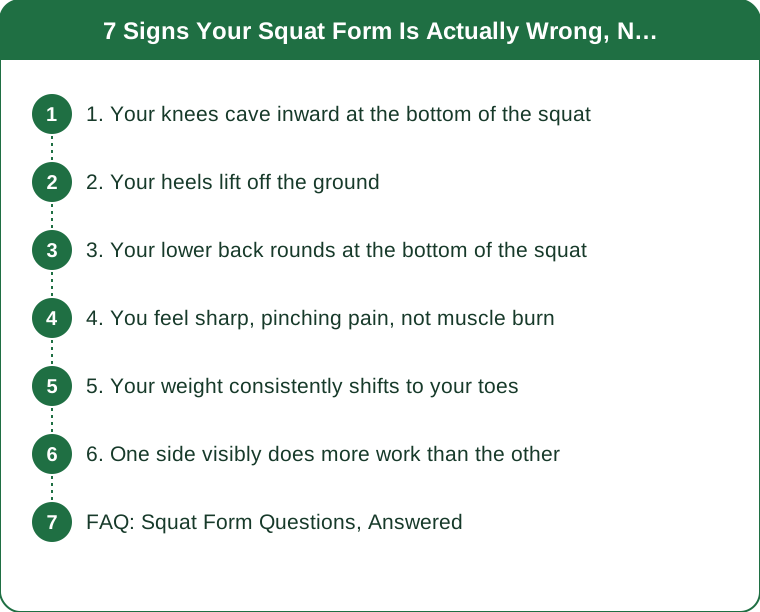
1. Your knees cave inward at the bottom of the squat
Called “knee valgus,” this usually points to weak glutes or hip external rotators not doing their stabilizing job. It’s one of the clearest, most consistent form flags because it’s visible and it does raise real injury risk over time, unlike sensations that are just about effort.
Is knee caving always a strength issue?
Usually, though sometimes it’s a cueing issue — actively thinking ‘knees out’ during the descent fixes it for many lifters even before the underlying strength catches up, which is why coaches cue it constantly.
2. Your heels lift off the ground
This typically signals limited ankle mobility, not a strength problem — the lifter physically can’t sit back far enough without the heel rising to compensate. Elevating the heels slightly (a small plate or squat wedge) is a legitimate short-term fix while separately working on ankle mobility over time.
Does heel lift always mean an injury risk?
Not immediately, but it does shift load in ways that reduce squat efficiency and can stress the knees over repeated heavy sessions — worth correcting rather than ignoring long-term.
3. Your lower back rounds at the bottom of the squat
Called “butt wink,” a slight rounding as you hit true depth is common and not automatically dangerous, but a pronounced round under load is a genuine flag — it usually means going slightly less deep, working on hip and hamstring mobility, or both.
How do I know if my back rounding is a problem?
If it happens only at your absolute deepest range and there’s no pain, it’s often just anatomy; if it happens well before full depth or comes with lower back pain, that’s the version worth addressing directly.

4. You feel sharp, pinching pain, not muscle burn
General muscle burn, shakiness under a heavy set, and post-workout soreness are all normal effort responses. Sharp, localized, pinching pain — especially in a joint rather than a muscle belly — is a genuine stop signal, not something to push through.
5. Your weight consistently shifts to your toes
Weight should stay balanced through the whole foot, favoring the mid-foot to heel. Toe-dominant weight shift often causes the exact heel-lift and forward-lean issues covered above, and frequently traces back to bar path or starting stance rather than a single isolated cue.
6. One side visibly does more work than the other
A visible lean, twist, or one hip riding higher than the other during the squat suggests a strength or mobility imbalance between sides, worth addressing with unilateral work (single-leg exercises) rather than just squatting more of the same movement.
Myth vs Fact
Myth: Any knee-tracking-past-toes movement is automatically bad form. Fact: Knees traveling past the toes is normal and often necessary for a deep, full-range squat — the actual flag is inward knee collapse, not forward travel. Myth: Squatting should never feel hard or shaky. Fact: Trembling under a challenging working set is a normal strength-training response, not a form failure — it’s genuinely different from the sharp pain or joint-specific pinching that does signal a problem.
FAQ: Squat Form Questions, Answered
Is it normal for squats to feel uncomfortable?
Yes — muscle burn, shakiness under load, and general fatigue are all expected. Sharp pain, joint pinching, and visible asymmetry are the signals actually worth addressing.
Should I stop squatting immediately if my knees cave in?
Not necessarily stop entirely, but reduce load and actively cue ‘knees out’ while addressing underlying glute and hip strength — pushing heavy weight through consistent knee valgus does raise injury risk over time.
When should squat discomfort see a professional instead of just more practice?
Sharp pain that doesn’t resolve within a day or two, or any pain that changes your gait afterward, is worth a physical therapist or doctor visit rather than working through it alone. This is general information, not medical advice.
TL;DR:
- Knee caving, heel lifting, and pronounced back rounding are genuine form flags
- General muscle burn and shakiness under load are normal, not form failures
- Sharp, joint-specific pain is always a stop signal
- Visible side-to-side asymmetry points to an imbalance worth training directly
Learning to tell effort from injury risk is what actually protects long-term squat progress. This is general information, not medical advice.
See It in Motion
Seen here: High Waist Printed Bootcut Yoga Pants with Pockets — shop it on bubblelime.com
Keep Reading
This article is for general informational and styling purposes only. Fit, sizing, and product availability may vary.