7 Signs Your Squat Form Is Actually Wrong — Not Just Uncomfortable
Quick Answer: Some squat discomfort is normal training adaptation, but specific patterns — knees caving in, heels lifting, sharp lower back pain, or an inability to hit consistent depth — point to actual form issues, not just beginner soreness, and are worth addressing before adding more weight or reps.
You’ve been pushing through some discomfort assuming it’s just part of getting stronger. Some of it probably is. But a few specific patterns are your form telling you something different, and catching them early saves a lot of frustration later.

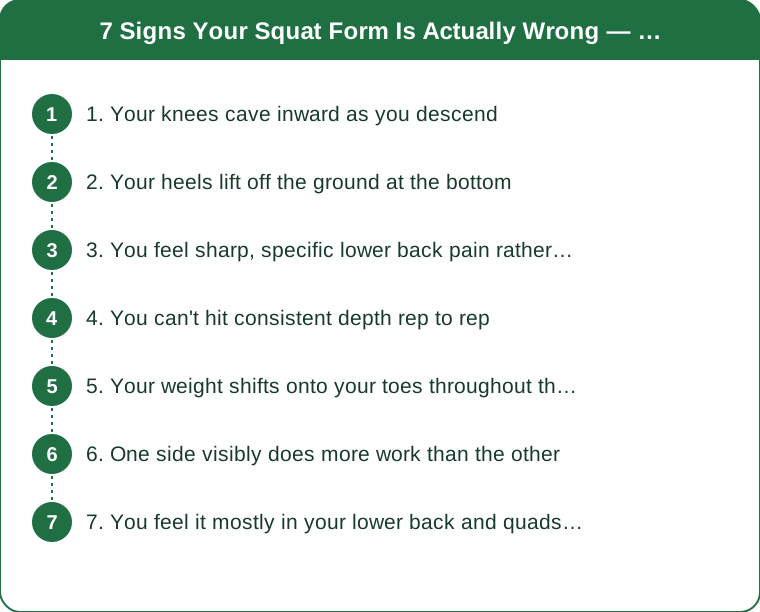
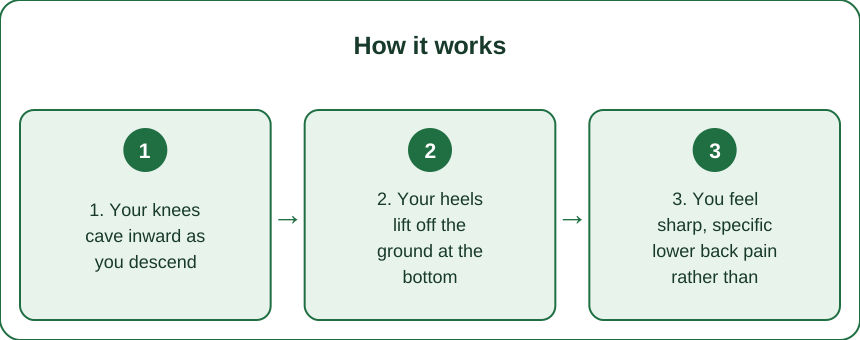
1. Your knees cave inward as you descend
Knees collapsing toward each other (valgus collapse) during the squat usually indicates weak hip abductor and glute medius muscles failing to keep the knee tracking over the toes. This isn’t just an aesthetic issue — it places uneven stress on the knee joint that can lead to pain over repeated reps if uncorrected. Cueing ‘push your knees out’ and adding banded lateral work can help retrain this pattern.
2. Your heels lift off the ground at the bottom
Heels rising during a deep squat often points to limited ankle mobility rather than a strength issue — your body compensates for restricted ankle flexion by shifting weight forward onto the toes. Elevated-heel shoes or a small plate under the heels can be a temporary workaround while ankle mobility work addresses the root cause over time.
3. You feel sharp, specific lower back pain rather than general fatigue
General muscular fatigue in the lower back after squats is common and expected; sharp, localized pain — especially during the movement itself rather than after — often indicates excessive forward lean or rounding of the lower back under load, which shifts stress from the intended muscles onto the spine directly. This is a sign to reduce weight and check torso positioning before continuing.

4. You can’t hit consistent depth rep to rep
Squat depth that varies noticeably between reps within the same set — some deep, some shallow — often signals fatigue outpacing your current working weight, or insufficient hip and ankle mobility to maintain the position under continued load. Consistent depth is a better indicator of controlled strength than occasionally hitting a deeper single rep.
5. Your weight shifts onto your toes throughout the movement
Weight that drifts forward onto the toes rather than staying distributed through the whole foot (with emphasis through the heel and midfoot) usually reflects either poor bar position (too far forward) or the same ankle mobility limitation causing heel lift. This forward shift reduces the posterior chain’s involvement in the lift and can strain the knees more than a properly balanced squat.
6. One side visibly does more work than the other
Visible asymmetry — one hip appearing to rise faster, one knee tracking differently than the other — often points to a strength imbalance between sides that the squat pattern is currently compensating around rather than correcting. Single-leg accessory work (split squats, step-ups) directly addresses this kind of imbalance better than more bilateral squatting alone.
7. You feel it mostly in your lower back and quads, barely in your glutes
A squat that’s supposed to engage the posterior chain but consistently feels concentrated in the quads and lower back, with minimal glute engagement, often indicates insufficient hip hinge in the movement pattern — the knees are doing most of the work that the hips should share. Consciously sitting the hips back further at the initiation of the squat usually redistributes that load more appropriately.
How do I know if my discomfort is normal soreness or one of these form issues?
Normal soreness is typically diffuse, appears a day or two after training, and affects muscles broadly; form-related discomfort tends to be sharper, localized, and often noticeable during the movement itself, not just afterward.
Should I stop squatting entirely if I notice one of these signs?
Not necessarily — reduce weight significantly, focus on the specific correction for that sign, and rebuild gradually rather than stopping the movement pattern entirely.
Is filming my own squats from the side actually useful for catching these issues?
Yes, very useful — several of these signs (heel lift, knee cave, inconsistent depth) are much easier to spot on video than to feel in the moment during the lift itself.
TL;DR:
- Not all squat discomfort is normal — knee cave, heel lift, sharp back pain, and inconsistent depth are specific form red flags
- Weight shifting onto the toes and visible side-to-side asymmetry both point to correctable technique issues
- Minimal glute engagement despite quad and back fatigue often means insufficient hip hinge in the pattern
- Filming your squat from the side is one of the most practical ways to actually catch these signs
Next squat session, film yourself from the side for one set — several of these seven signs are far easier to catch on video than to feel while you’re mid-rep.
See It in Motion
Seen here: High Waist Bootcut Yoga Pants with Hidden Pocket — shop it on bubblelime.com
Keep Reading
This article is for general informational and styling purposes only. Fit, sizing, and product availability may vary.