7 Reasons Your Warm-Up Sets Feel Heavier Than Your Working Sets
Quick Answer: Light loads feel disproportionately hard because you have not yet recruited high-threshold motor units, the bar path is less stable without load, tissue is cold and stiff, and the light bar gives you no proprioceptive feedback to organise against. Post-activation potentiation then makes later sets genuinely feel easier at heavier loads. It is a normal, well-documented pattern and a longer, better-structured warm-up shortens it considerably.
If the empty bar feels terrible and the working weight feels good, your warm-up is too short rather than your form being broken.
This blog has covered nine squat warm-up moves that change your first set, why your squat feels different every session, and eight reasons it feels worse after a week off. This is the specific version that confuses people most.

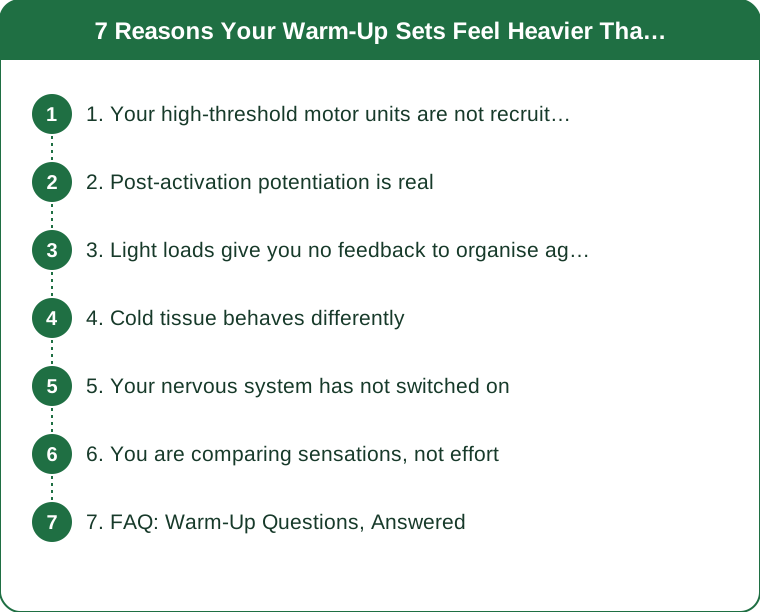
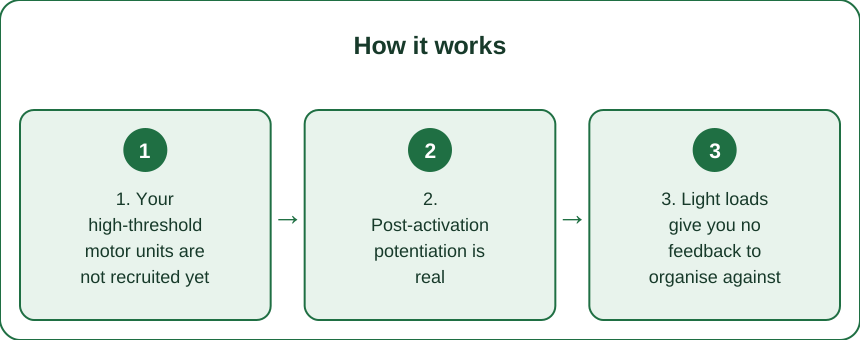
1. Your high-threshold motor units are not recruited yet
Muscle fibres are recruited in order of size, and the big ones do not show up for light work.
The size principle means small, fatigue-resistant motor units activate first and larger, more powerful ones only engage as force demand rises.
An empty bar demands almost no force, so the fibres capable of moving your working weight are essentially idle.
You are therefore squatting the light bar with a fraction of your available musculature, which genuinely feels less stable and less strong.
Recruitment improves through the warm-up, which is exactly why set four often feels better than set one at a heavier load.
This is also why jumping straight to a moderate weight can feel better than a very long light warm-up — though it is a worse idea for joint preparation.
The practical version: include one or two sets at a moderately challenging weight before your first working set, rather than only very light ones.
2. Post-activation potentiation is real
Heavy work makes subsequent work feel easier, and warm-up work makes heavy work possible.
Potentiation is a short-term increase in force output following a prior contraction, typically peaking a few minutes after a heavy or explosive effort.
It is why the second working set frequently feels better than the first, despite accumulating fatigue.
It also means the last warm-up set primes the first working set, so skipping it costs you more than the time it takes.
The window is roughly three to eight minutes for most people, which is why very long rests between the last warm-up and the first working set lose the benefit.
Fatigue and potentiation coexist, and the balance between them is what makes some sessions feel like they get easier and others like they degrade from set one.
Practically: keep your last warm-up set close in time to your first working set — three to five minutes rather than ten.
3. Light loads give you no feedback to organise against
The bar is a source of information as well as a load.
Proprioception improves with load. A heavy bar tells you clearly where it is, where your weight is, and whether you are drifting forward.
An empty bar tells you almost nothing, so your body has to organise the movement with far less information than it is used to.
Bracing has nothing to brace against. Intra-abdominal pressure works against load, and without it the setup feels vague and unstable.
This is why some people genuinely squat with better positions at 70 percent than at 20, which looks alarming but has a straightforward explanation.
It is also why the empty bar is a poor tool for form checking despite being the standard advice.
Use a goblet squat or a moderately loaded bar for technical work instead. The load gives you something to organise against and produces a more representative movement.

4. Cold tissue behaves differently
Muscle and tendon are viscoelastic, and viscosity matters more than most people account for.
Cold muscle is stiffer and produces force more slowly. Rate of force development is measurably lower before a warm-up.
Tendon compliance changes with temperature, altering how the whole system stores and returns energy.
Joint synovial fluid is more viscous when cold, which is a large part of why the first few reps of anything feel restricted.
Range of motion is genuinely reduced, so early squats feel shallower or more effortful at the bottom.
This is worse in a cold gym and in the winter, and it is why the same warm-up protocol needs to be longer from November onwards.
Five to ten minutes of general movement before you touch a bar does more for this than any amount of stretching.
5. Your nervous system has not switched on
Arousal level is a performance variable and it takes time to rise.
Sympathetic activation improves force production, reaction time and coordination, and it starts low if you have come straight from a desk.
Early sets are also where your attention is worst. You are thinking about your day, your phone, the setup, not the movement.
Motor patterns need rehearsal each session, and the first few sets are that rehearsal, not a test.
Time of day matters here. Morning training has both lower core temperature and lower arousal, which is why early sessions need a longer ramp.
Music, a few explosive movements, or a couple of jumps genuinely help and are not just ritual.
Which means judging the session by the first set is a mistake. The first set is usually the least representative one you will do.
6. You are comparing sensations, not effort
Light sets feel bad in a different way than heavy sets feel hard.
A light set feels unstable, awkward and wobbly. A heavy set feels hard but organised. People rate the first as worse even though it is objectively easier.
Awkwardness is more unpleasant than effort for most people, particularly in a movement they are trying to perform well.
You are also paying much closer attention during warm-ups, so every imperfection registers.
Fear of the working weight colours the warm-up too. Anticipating a hard set makes the light ones feel worse than they are.
And the memory is asymmetric. A good working set is memorable; a wobbly empty bar is memorable. The middle sets vanish.
Reframing helps more than it sounds like it should: warm-up sets are rehearsal, not evidence.
7. FAQ: Warm-Up Questions, Answered
Why does the empty bar feel harder than my working weight?
Because light loads do not recruit your high-threshold motor units, give you almost no proprioceptive feedback, and provide nothing to brace against. Meanwhile your tissue is still cold and your nervous system is not yet switched on. It is a well-recognised pattern, not a form problem.
How many warm-up sets should I do before squatting?
Usually five to ten minutes of general movement, then three to five ramping sets ending with one at a moderately challenging weight, taken close in time to your first working set. Ending your warm-up on something too light loses the potentiation benefit.
Should I check my squat form with an empty bar?
Not as your only check. An empty bar gives you little to brace or organise against, so it often produces a less representative movement than a goblet squat or a moderately loaded bar. Use light loads to rehearse the pattern and moderate ones to assess it.
This is general information, not medical advice. Persistent pain during warm-ups is worth getting assessed rather than warming up through.
TL;DR:
- Light loads do not recruit the fibres that move your working weight, and give you nothing to brace or organise against.
- Post-activation potentiation genuinely makes later, heavier sets feel better. Keep the last warm-up set within a few minutes of the first working set.
- Cold tissue is stiffer and slower. Five to ten minutes of general movement before the bar matters more in winter than summer.
- Judge the session on set three, not set one. The first set is the least representative thing you will do all day.
If the empty bar feels terrible and 80kg feels fine, that is your physiology working as designed — not a warning sign.
See It in Motion
Seen here: Bootcut Capri Yoga Pants with Pockets — shop similar styles on bubblelime.com
Keep Reading
This article is for general informational and styling purposes only. Fit, sizing, and product availability may vary.