7 Reasons Your Squat Feels Completely Different From One Session to the Next
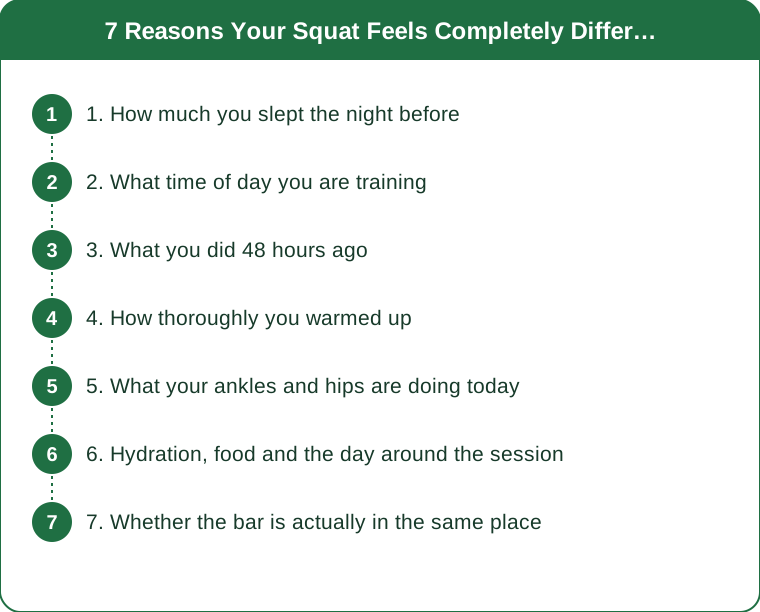
Quick Answer: Day-to-day squat variance is normal and mostly explainable: sleep, time of day, what you did 48 hours ago, warm-up quality, ankle and hip mobility state, hydration and fuelling, and bar position consistency. Expect a genuine 5 to 10% swing in how a given weight feels. Autoregulate — train to a target effort rather than a fixed number — and stop treating a heavy-feeling day as a failure.
Last Tuesday it flew up.
This Tuesday the same weight buried you.
Seven things changed. Here they are.

1. How much you slept the night before
The largest single variable, and the least respected.
Sleep loss affects force production and coordination. Even a single short night reduces both maximal strength and, more noticeably, the smoothness of a movement pattern.
Rate of force development suffers before maximum strength does. This is why the bar feels sluggish out of the hole rather than genuinely impossible — the top-end strength is largely there, the speed is not.
Perceived effort rises independently of actual output. The same weight genuinely feels heavier on poor sleep even when you can still lift it, which affects your decisions for the rest of the session.
Two consecutive short nights compound more than one bad one. A single bad night is manageable; a bad week is when programmes start failing.
Practical response: on poor sleep, keep the session, reduce the load by 10 to 15% and focus on movement quality. Training on bad sleep is fine; testing on bad sleep is not.
2. What time of day you are training
Your strength has a daily rhythm, and it is larger than most people assume.
Strength peaks in the late afternoon and early evening for most people. Core body temperature is at its highest and neuromuscular efficiency follows it.
Morning sessions start at a genuine disadvantage. Lower core temperature, stiffer tissue, and less time on your feet all reduce output. The difference between a 6am and a 5pm session can be several percent on the same lift.
Morning training adapts over weeks. Consistent early training improves morning performance, but it never fully closes the gap.
Spinal compression is a real factor for squats specifically. You are measurably shorter in the evening than in the morning, and intervertebral discs are more hydrated and stiffer first thing.
The implication: comparing a Tuesday morning session with a Thursday evening one is not comparing like with like. Keep your comparisons within the same time slot, or accept that the numbers are not directly comparable.
3. What you did 48 hours ago
Fatigue arrives later than people expect and lands on unrelated sessions.
Delayed onset muscle soreness peaks at 24 to 72 hours. A hard Saturday can be at its worst on Monday.
Neural fatigue lasts longer than muscular fatigue. A heavy session leaves the nervous system flat for 48 to 72 hours, which shows as sluggishness rather than soreness.
Non-training activity counts. A long walk, a day of standing, a house move. These load the same tissue and rarely get logged.
Hard conditioning interferes with strength for a day or two. The interference effect is real, and a hard interval session two days earlier will show up in your squat.
Eccentric-heavy work has the longest tail. Slow lowering, deep lunges and downhill running all produce a longer recovery window than concentric work.
Practical response: keep a simple log of everything, not just training. Most mysterious bad sessions become obvious once you can see what happened two days earlier.

4. How thoroughly you warmed up
The most controllable factor on this list, and the one people cut when short of time.
Tissue temperature changes force production directly. Warm muscle produces more force and moves more freely. Raising core temperature takes 5 to 10 minutes, not two.
Ramping sets do more than mobility work. Progressive warm-up sets rehearse the pattern under increasing load and prime the nervous system. Empty bar, then 40%, 60%, 80% is a reasonable structure.
Rushed warm-ups produce the classic first-work-set surprise. The set that feels far heavier than it should, followed by the second one feeling fine, is a warm-up problem almost every time.
Cold environments need longer. A cold garage gym in autumn needs a meaningfully longer warm-up than a heated commercial gym, and this is a common cause of bad sessions from October onward.
Consistency matters more than content. The same warm-up every session removes it as a variable, which makes everything else easier to interpret.
5. What your ankles and hips are doing today
Mobility fluctuates far more than strength does.
Ankle dorsiflexion limits squat depth directly. Restricted ankles force you forward, shift load to the lower back and change the whole feel of the lift. Ankle range varies noticeably day to day.
Sitting all day reduces hip mobility measurably. A day at a desk before an evening session produces a genuinely different squat from a day on your feet.
Previous day’s activity changes both. Long walks, cycling, or a long drive all leave their mark.
Footwear changes the whole pattern. Squatting in flat shoes one week and lifting shoes the next produces two different movements. Raised heels reduce the ankle mobility demand substantially.
A quick assessment is worth doing. A knee-to-wall ankle test takes ten seconds and tells you which kind of session you are having before you get under the bar.
Practical response: two or three minutes of ankle and hip work in the warm-up, every session. It is the cheapest consistency you can buy.
6. Hydration, food and the day around the session
Small effects individually, meaningful when they stack.
Even mild dehydration reduces strength performance. A 2% body mass loss is enough to matter, and it is easily reached across a warm day without noticing.
Carbohydrate availability matters for volume, not for a single heavy single. A low-carbohydrate day shows up in set four, not set one.
Meal timing changes how you feel under the bar. A large meal too close to a session makes bracing uncomfortable — 2 to 3 hours is a reasonable gap.
Caffeine is a genuine but variable performance aid. It reliably improves output for most people, and inconsistent use creates inconsistent sessions. Same dose, same timing, or none at all.
Stress raises perceived effort independently of physiology. A difficult day genuinely makes the same weight feel heavier.
The pattern to look for: if bad sessions cluster on particular days of the week, the cause is usually in this category rather than in your programme.
7. Whether the bar is actually in the same place
Small setup differences produce large feel differences.
A high-bar and low-bar position are different lifts. Even a 2cm difference in bar placement changes the moment arm, the muscles emphasised and how the weight feels.
Stance width and foot angle drift over time. Without a deliberate marker, most people’s stance wanders week to week, and a slightly wider or narrower stance changes depth and hip contribution.
Bracing consistency is the hidden one. How much air you take and how hard you brace before descending changes trunk stiffness substantially — and it varies enormously when you are not deliberate about it.
Grip width affects upper back tightness, which affects the shelf the bar sits on and how connected the whole thing feels.
Bar knurling and different bars matter more than people admit. A different bar with different whip and knurl genuinely changes a heavy squat.
Practical response: film one set a week from the side. Most session-to-session mysteries resolve immediately on video, and setup drift is the most commonly discovered cause.
This is general information, not medical advice. Persistent pain during squatting warrants assessment by a qualified professional.
TL;DR:
- A 5 to 10% day-to-day swing in how a weight feels is normal, not a sign of a failing programme.
- Sleep is the biggest variable, followed by time of day and what you did 48 hours ago.
- A consistent, unrushed warm-up removes the most controllable source of variance.
- Ankle and hip mobility fluctuate more than strength does — two minutes of prep every session.
- Film one set a week. Setup drift explains more mystery sessions than anything else.
This week, use the same warm-up and the same time slot twice, and film one set. Two of the seven variables disappear immediately.
See It in Motion
Seen here: High Waist Embossed Yoga Leggings with Side Pockets — shop it on bubblelime.com
Keep Reading
This article is for general informational and styling purposes only. Fit, sizing, and product availability may vary.