7 Reasons Your Squat Depth Feels Fine Alone But Falls Apart in Class
Quick Answer: Squat depth usually collapses in class due to pace, fatigue, and reduced focus on form cues compared to solo practice — slowing down your tempo and prioritizing depth over speed during class fixes most of the gap.
At home, your squat looks textbook. In class, following the instructor’s pace, it quietly gets shallower every round. Here’s why that gap exists.

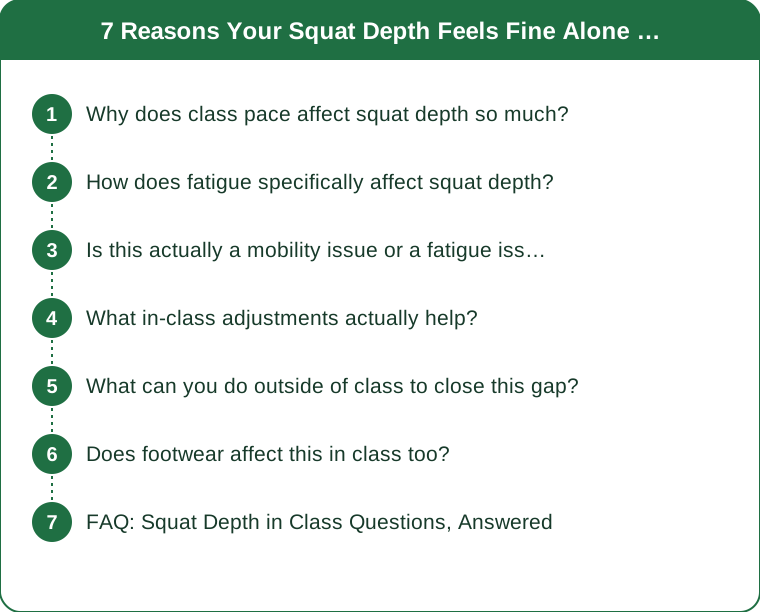
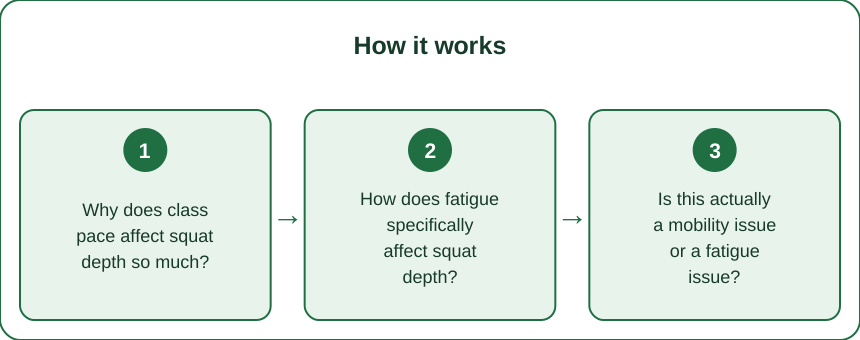
Why does class pace affect squat depth so much?
Group tempo often outpaces your control
Instructor-led pacing is set for the average of the room, which may be faster than the tempo you use for controlled depth practice alone, pushing you to sacrifice depth for speed just to keep up.
Less individual feedback in a group setting
Solo practice, especially in front of a mirror, gives constant visual feedback on depth and form, while a group class offers far less individual correction, letting small depth losses go unnoticed round after round.
How does fatigue specifically affect squat depth?
Ankle and hip mobility fatigue first
The muscles and connective tissue that allow deep squat range of motion fatigue faster than the larger muscle groups doing the lifting, which means depth often degrades before strength does within a single session.
Compensation patterns emerge under fatigue
As fatigue sets in, most people unconsciously shift toward a shallower squat with more forward lean to compensate, since it requires less ankle and hip mobility to complete the same number of reps at pace.
Is this actually a mobility issue or a fatigue issue?
Often it’s both, but mobility limits show up first
Limited ankle dorsiflexion or hip mobility sets a ceiling on how deep you can squat with good form even when fresh, and fatigue then erodes whatever margin you had above that ceiling.
A simple test can tell you which is bigger
If your squat depth is shallow even in the very first rep of a fresh set, that points to a mobility limiter; if it’s fine for the first several reps and then degrades, that points more toward fatigue and pacing.

What in-class adjustments actually help?
Deliberately taking a slightly slower tempo than the group on your own squats, even if it means falling half a beat behind the instructor’s count, preserves depth and form far better than matching group pace exactly. Most instructors would rather see a controlled, appropriately deep squat slightly out of sync than a fast, shallow one perfectly on beat.
What can you do outside of class to close this gap?
Ankle mobility work (like weighted ankle stretches or calf-raise-to-squat transitions) and hip opener stretches, done consistently a few times a week, raise your baseline mobility ceiling, which gives you more depth margin to work with even as class-induced fatigue sets in.
Does footwear affect this in class too?
Yes — thick-soled shoes can reduce ankle mobility and effective squat depth compared to flatter, more minimal soles or bare feet, so footwear choice for classes involving heavy squat work is worth reconsidering if depth has been a consistent struggle.
FAQ: Squat Depth in Class Questions, Answered
Should I skip reps in class rather than do shallow squats?
Slowing your pace slightly, rather than skipping reps entirely, usually preserves both the conditioning benefit and your form better than either extreme.
How long does it take to see mobility improvements affect squat depth?
Consistent ankle and hip mobility work often shows a noticeable difference in squat depth within 3-4 weeks, though full improvement can take longer.
Is it worth telling the instructor if pace is preventing good depth?
Yes, most instructors appreciate this feedback and can offer modifications or acknowledge that quality over speed is the priority for that particular movement.
TL;DR:
- Group pace often outstrips the tempo needed for full depth
- Ankle and hip mobility fatigue before your bigger muscles do
- Test whether it’s a mobility ceiling or a fatigue drop-off
- Slow your own tempo slightly rather than matching class pace exactly
- Ankle and hip mobility work outside class raises your depth ceiling
If your squat looks perfect alone but falls apart in class, the fix usually isn’t more strength work — it’s pace, mobility margin, or both.
See It in Motion
Seen here: Super High Waist Embossed Yoga Leggings with Inner Pocket — shop it on bubblelime.com
Keep Reading
This article is for general informational and styling purposes only. Fit, sizing, and product availability may vary.